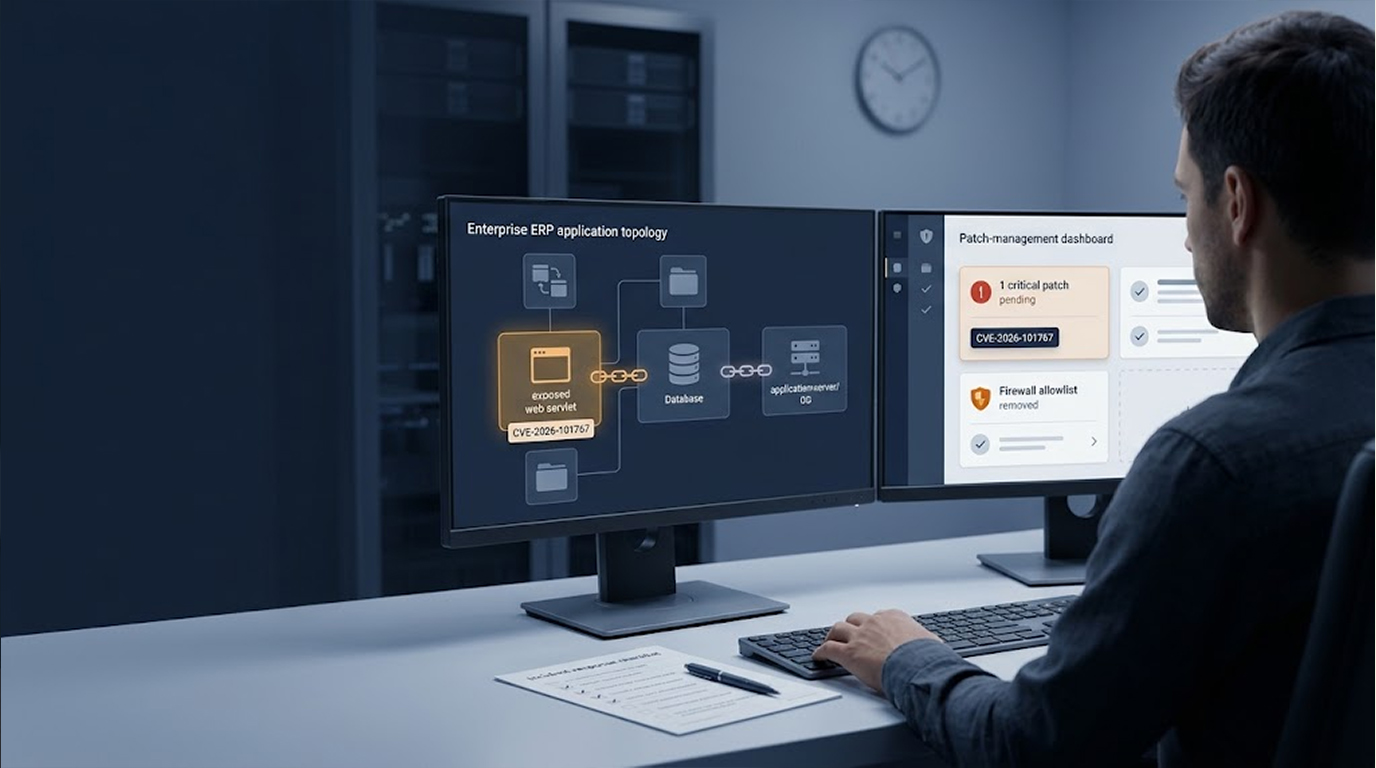
Threat actors are already probing for a newly patched critical vulnerability in Oracle E-Business Suite, because threat intelligence firm Defused Cyber just confirmed that its decoys recorded exploratory exploits against CVE-2026-101767 on the morning of October 27, which means the window to patch your EBS deployment is closing fast.
The flaw carries a CVSS score of 9.8, it sits in the Oracle Application Object Library of Oracle E-Business Suite, and Oracle patched it last week as part of its Critical Patch Update. But the exploits are already in the wild.
The Technical Anatomy of CVE-2026-101767
Security researchers Brandon Peterson, Jimi Sebree, and Noah King of Horizon3.ai are credited with discovering and reporting the flaw to Oracle on July 24, 2026, and their advisory paints a very clear picture of the attack chain.
This is an unauthenticated SQL injection in EBS's Thin Client Framework servlet that chains to remote code execution. Specifically, an attacker with network access to the affected TCF servlet can execute SQL as the APPS database user, then run operating system commands as the EBS application account.
Here is exactly how it works: the attacker issues a crafted request to /OA_HTML/AppsTCFServer to run SQL with the privileges of the APPS database user, and ultimately enables system command execution with the privileges of the EBS application account. Successful exploitation lets an attacker read or modify application data accessible to APPS and execute commands on the application host.
|
Attack Stage |
Action |
Privilege Gained |
|
1. Initial Access |
Crafted request to /OA_HTML/AppsTCFServer |
Unauthenticated access |
|
2. SQL Injection |
Execute SQL as the APPS database user |
APPS database privileges |
|
3. Command Execution |
Run OS commands via the EBS application account |
EBS application account privileges |
|
4. Impact |
Read/modify financial, payroll, HR, procurement data |
Full control of application host |
What Data Is at Risk
Horizon3.ai is warning that depending on the deployment, affected data may include financial, payroll, HR, and procurement records. Operating system access is governed by the permissions of the compromised EBS application account.
While internet-facing EBS deployments present the most risk, internal EBS systems can also be exploited if an attacker can reach the vulnerable servlet from a compromised system or another accessible network segment.
Why This Is Especially Dangerous
Vulnerabilities in EBS have been a hot target for attackers over the past year, and this is not the first time EBS has been in the crosshairs. Two critical flaws in the same product (CVE-2025-61882 and CVE-2026-46817, both CVSS 9.8) have come under active exploitation, with the former leveraged by the Cl0p ransomware and extortion crew.
That track record means attackers are already familiar with EBS, they know where to look, and they know how much damage they can do.
How to Patch and Mitigate
Oracle has released a patch as part of its Critical Patch Update, and you should update to the latest version as soon as possible.
If immediate patching is not an option, the following workarounds can be applied:
- Remove /OA_HTML/AppsTCFServer from the EBS URL firewall allowlist. This servlet will be linked to oracle.apps.fnd.tcf.SocketServer, and removing it eliminates the entire attack vector.
- Limit access to EBS web tier from trusted network only.
- Monitor the EBS application host and database for signs of compromise.
Indicators of Compromise
Horizon3.ai has also shared specific indicators of compromise that defenders should hunt for immediately:
- Unauthenticated POST requests to /OA_HTML/AppsTCFServer that instantiate the Gantt data-server class (oracle.apps.jtf.gantt.server.GanttDataServer), followed by backend database activity.
- SQL reconnaissance shortly after unauthenticated web requests (database version, current user, directory objects).
- Unexpected files in $APPLPTMP and the oracle account spawning /bin/sh via the Concurrent Manager to run OS commands.
FAQ
What is CVE-2026-101767?
It is a 9.8 severity unauthenticated SQL injection flaw in Oracle E-Business Suite's Thin Client Framework servlet. If an attacker exploits it, they can run SQL as the APPS database user and then execute OS commands as the EBS application account.
Has this been exploited in the wild?
Yes. Defused Cyber confirmed that its Oracle EBS decoys recorded exploratory exploits against CVE-2026-101767 on October 27. The attacks are actively probing for vulnerable systems right now.
How do I fix it?
Oracle patched the flaw in its Critical Patch Update. You need to update to the latest version immediately. If you cannot patch right away, remove /OA_HTML/AppsTCFServer from your EBS URL firewall allowlist.
Why is this flaw so dangerous?
Because it chains an unauthenticated SQL injection directly to remote code execution. An attacker doesn't need a password or any existing access. All they require is network connectivity to the vulnerable servlet, and then they can even read the company’s financials, payroll, human resources, and procurement information.
What am I supposed to look out for in my logs?
Unauthenticated POST requests on /OA_HTML/AppsTCFServer, SQL queries against the database, unusual files on $APPLPTMP, and oracle account executing /bin/sh through Concurrent Manager.