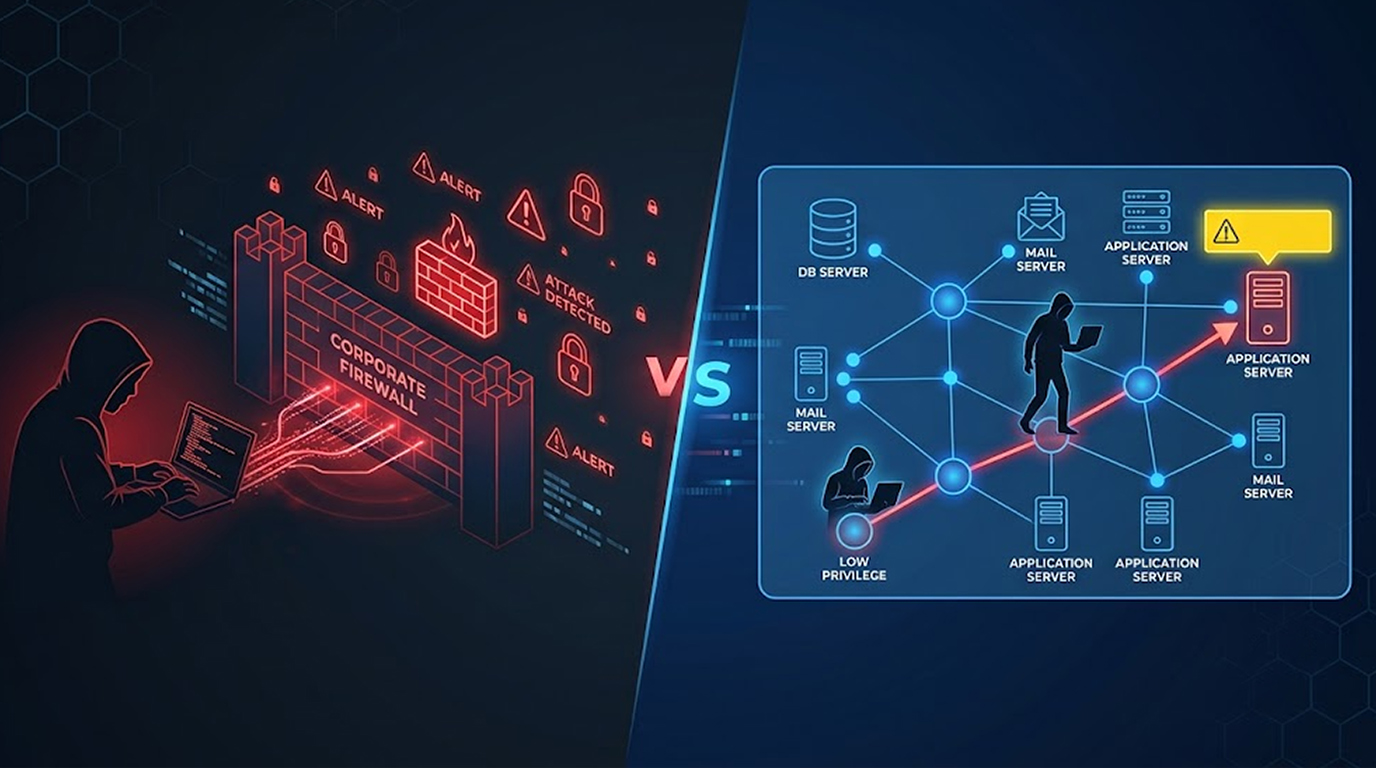
Security breaches are making headlines daily. From major corporations to small businesses, no organization is immune. Yet many business owners remain confused about one fundamental question: Should we test our external defenses or our internal network first?
The cybersecurity landscape has shifted dramatically. Attackers are no longer just hammering at the front door, they are finding creative ways to slip through windows, crawl through ventilation shafts, and sometimes walk right through the front door using legitimate credentials.
This guide cuts through the confusion. The team at Red Secure Tech LTD explores the critical differences between internal and external penetration testing, explains why most organizations need both, and provides clear guidance on prioritizing testing strategies.
What Is External Penetration Testing?
External penetration testing simulates an attack from outside the organization. Ethical hackers try to exploit the security perimeters using the same techniques and tools used by the actual malicious attackers.
The target areas include:
1. Public web sites and applications
2. E-mail servers and communication gateways
3. Endpoint for Virtual Private Network (VPN)
4. Firewalls and edge routers
5. Public application program interfaces (APIs)
6. File transfer protocol (FTP) sites and other file transfer systems
The process normally occurs in this sequence:
1. Reconnaissance: Collecting any information that is publicly available regarding the targeted organization
2. Scanning: Discovering open ports, services, and software versions
3. Enumeration: Finding user names, shares, and applications
4. Exploitation: Trying to penetrate the system using the found vulnerabilities
5. Post-Exploitation: Establishing what data or systems have been accessed
External testing answers a fundamental question: "What can an attacker see and exploit from the internet?"
What Is Internal Penetration Testing?
Internal penetration testing takes a different approach. As opposed to approaching the system from an external angle, testers begin testing from within the network environment.
The following are some of the key areas to look at:
1. Internal server and workstation
2. Active Directory Environment
3. Segmentation and zoning of the network
4. Privilege escalation possibilities
5. Lateral movement skills
6. Web application and database embedded in the web application
Methodology key points:
1. Footprint – performing tests using valid user credentials
2. Lateral Movement – scanning the network for additional systems
3. Privilege Escalation – trying to obtain admin access
4. Data discovery – searching for any useful information
5. Persistence – ensuring the availability of backdoors.
Internal testing asks another question: "What if someone already got in, how much trouble could he cause?"
Key Differences Between Internal and External Testing
Understanding the distinctions helps organizations make informed security decisions.
Starting Point and Assumptions
External testing assumes zero prior access. Testers know nothing about the internal environment and must work entirely from publicly available information.
Internal testing assumes some level of access already exists.
This might represent:
1. Compromised employee workstation
2. Malicious insider
3. Phishing attack success
4. Supply chain breach
Threat Actors Emulated
External pen testing emulates threats coming from the external sources, such as cybercriminals, hacktivists, and scanning tools. Threat actors of this kind are mostly financially or reputably motivated.
The process of internal penetration testing attempts to recreate attacks which can originate from within the organization; examples may include malicious insiders, infected users, and attackers who have been able to penetrate the perimeter. The reasons for these attacks range from data theft, sabotage, and espionage.
Security Vulnerabilities Identified
In the case of external testing, these include:
1. Unpatched public-facing applications
2. Incorrectly configured firewalls
3. Default passwords of any exposed device
4. Vulnerabilities of web applications such as SQL injection attacks
5. Information leaks from error messages
Internal testing will find:
1. Over-privileged access given to users
2. Poor internal password policy
3. Poor network segmentation
4. Unpatched internal systems
5. Insecure communication protocols
Why organizations Need Both Types of Testing
Relying on a single testing approach leaves dangerous blind spots.
The Complete Attack Chain
Modern attacks rarely stop at the perimeter.
Think of this situation:
A phishing mail affects one employee's computer only. The intruder is now within the network but with restricted permissions. Using this as a base of operations, he scans the systems internally for a vulnerable system, exploits it to get administrator privileges, and accesses the customer database.
External testing alone would have missed this completely. The perimeter defenses might be flawless, but the internal security posture is where the real damage occurs.
Internal testing alone presents the opposite problem. An organization might have excellent internal controls, but if an attacker can breach the perimeter trivially, those internal controls never come into play.
The reality is simple: organizations need visibility across the entire attack surface.
Compliance Requirements
Regulatory frameworks increasingly demand both perspectives:
1. PCI DSS: Requires external and internal scanning and penetration testing. As per the requirements of PCI DSS 4.0, the organization needs to carry out internal and external penetration testing annually and after each change which impacts the CDE.
2. GDPR: Requires adequate technical controls that include testing of perimeter and internal controls. Penetration testing is useful to obtain evidence of the testing of controls.
3. ISO 27001: Recommends penetration testing periodically covering all relevant areas.
4. Cyber Essentials Plus: Requires penetration testing internally and externally.
5. DORA: Requires Threat Led Penetration Testing (TLPT).
Risk-Based Decision Making
Not all threats demand the same defenses. External testing proves perimeter spend. Internal testing proves segmentation, monitoring, and access control spend. Both are needed to ensure risk alignment of your security investments.
Which Should a Business Prioritize?
The answer depends on the organization’s specific circumstances. Here is practical guidance.
Conduct External Testing First in Cases Where:
1. There has been no prior penetration testing exercise conducted. External testing lays down the initial groundwork for understanding the vulnerabilities.
2. New application or service is up and running. Websites, API and customer portals are new sources of vulnerability.
3. The regulation requires that external testing takes place. It is necessary to comply with the regulations by conducting external testing first.
4. Quick results should be obtained. This can be done through external testing.
Internal testing must be prioritized when:
1. External testing has already been conducted. Once there have been corrections made on the threats to the perimeter security, the focus goes to the internal testing.
2. The Zero Trust model has been implemented. Internal testing will help validate access and segmentation.
3. Confidential data is located in the internal environment. Companies that have credit card details of clients, health data, or intellectual property fall under this category.
4. There is an opportunity for insider threats. Irrespective of the intentions behind the actions, internal testing will reveal which insiders have access.
Recommended Strategy
Most organizations would adopt a recommended strategy that involves the following:
1. External penetration testing to locate and remediate any gaps in the security perimeter.
2. Internal penetration testing to know how a breach will affect the internal systems.
3. Testing cycles for ensuring the integrity of security in varying environments.
The layers mentioned above ensure total coverage for the organization, which also makes the expenditure of funds more effective.
Real-World Consequences of Limited Testing
Understanding the stakes helps justify investment.
Case Study: The Missing Internal Test
A professional services firm had invested heavily in external security. Their firewall was robust, their public-facing applications were clean, and they passed external penetration tests with flying colours.
The firm had never tested internally.
When the team at Red Secure Tech LTD conducted an internal assessment, the results were alarming. Any employee with regular network access would be able to do the following:
1. Browse through all the customer databases
2. View all financial information in the company
3. Read all the company’s strategy documents
4. Make changes to system configurations
The firm had spent significant resources defending the front door while leaving the entire building unlocked from the inside.
A single compromised employee laptop from a phishing email, a malicious USB device, or simply a lost credential would have exposed every client record they held.
Case Study: The Perimeter Breach
A different client, an e-commerce retailer, had excellent internal controls. Network segmentation was strict, access was limited, and internal testing showed minimal risk.
But the situation was different regarding their perimeter defenses. Vulnerability in their third-party payment plug-in helped the hackers inject a skimming script which resulted in the harvesting of the card details of their customers at the time of checkout.
The retailers had concentrated on the security inside while ignoring the threat present outside.
Both cases demonstrate the same lesson: security is only as strong as the weakest link.
The Financial Impact
Security breaches are expensive. Beyond the immediate remediation costs, organizations face:
1. Fines for non-compliance (the maximum fine under GDPR is 20 million euros or 4 percent of annual worldwide turnover)
2. Costs related to legal advice and compensation
3. Negative impact on reputation and loss of business
4. Increased insurance costs
5. Cost of the investigation
According to the IBM 2024 Cost of a Data Breach report, the average total cost of a data breach is $4.88 million. Organizations usually surpass this figure owing to the strict regulatory environment.
Penetration testing, by contrast, represents a fraction of these potential losses. A comprehensive internal and external testing programme typically costs less than 1% of the potential breach liability.
Mistakes That Should be Avoided
Mistake 1: Testing for Compliance Only
It should be remembered that compliance with laws is only the starting point. Compliance requirements are usually minimal and not necessarily comprehensive in nature. Organizations that conduct testing only to meet compliance standards are still vulnerable to new threats.
Mistake 2: Lack of Regular Testing
Security risks are constantly changing. A test done one year ago might not represent today’s risk profile. The system may have become vulnerable to something new, there could be a new application installed, and configuration changes would be required.
Recommended schedule:
1. External testing: Annual or upon any major changes
2. Internal testing: Annual or upon any major infrastructure changes
3. Critical applications: Quarterly or upon any major release
Under PCI DSS 4.0, “major change” includes any infrastructure, data flow, software deployment, or boundary change.
Mistake 3: Lack of Remediation for Findings
Tests that do not lead to fixes are a formality. It’s common practice for many organizations to conduct penetration tests and get comprehensive findings but ignore their findings.
Formulate a plan for remediation with defined ownership and deadlines. Re-test findings after fixes have been implemented.
Mistake 4: Testing Production Environments Only
Production environments need testing, but testing must also take place in staging, development, and disaster recovery environments. These environments have similar weaknesses to the production environment but do not receive as much attention.
Mistake 5: Segmenting the Network as a Diagram rather than Demonstrating Segmentations under Attack
Segregation testing should show that networks which are not supposed to be within scope can access the CDE. This should involve firewall configurations, routing, ACLs, identity boundaries, and lateral movement paths.
Conclusion: Developing an Effective Testing Program
Internal and external penetration tests serve different but mutually beneficial purposes.
External penetration testing demonstrates the robustness of the perimeter security system to withstand attacks. On the other hand, internal testing ensures that even when the perimeter fails, the problem is contained.
Most organizations require both. A general optimal order might be:
1. External Testing – To uncover vulnerabilities on the perimeter
2. Internal Testing – To find out what will happen after the compromise
3. Recurrent and ongoing testing as environments change
4. Constant improvement based on test results
Takeaways:
1. External testing addresses the question: “What do attackers see?”
2. Internal testing answers the question: “What do they do afterwards?”
3. Both testing types are needed for complete understanding
4. To prioritize according to context and maturity
5. Ongoing testing is critical due to changing threats and environment
FAQ
How does internal penetration testing differ from external penetration testing?
In external penetration testing, the attack simulation is performed against the boundaries of the organization’s network, including the security of websites, firewalls, and virtual private networks. In internal penetration testing, the attack simulation is conducted within the organization’s network to know the extent of the damage that may be caused to the network.
Which penetration test should a company choose as their priority?
As a rule, the first priority for most organizations should be the external penetration test, especially if a company has never conducted any tests before. Once all the weaknesses of the external perimeter have been addressed, the second step would be the internal penetration test.
What exactly does each of these types of penetration testing entail?
External testing includes the examination of publicly available resources, such as websites, email servers, VPNs, firewalls, APIs, and FTP servers. Internal testing includes the examination of internal infrastructure resources, such as servers, workstations, Active Directory, network segmentation, privilege escalation techniques, and internal applications.
Why do businesses require each of them?
Since most threats do not stay within the confines of the perimeter. The exploitation of even one employee workstation will result in the entire network being exposed to attack if there are no proper internal controls. One cannot be done without the other.
Red Secure Tech LTD – How We Can Help
We at Red Secure Tech LTD offer an array of services in relation to pen testing for companies operating in the UK.
These services include:
1. External penetration testing: Discovering weaknesses in perimeters before they get exploited by hackers
2. Internal penetration testing: Understanding the scenario after the intrusion
3. Full range testing: Performing both external and internal pen testing for maximum coverage
4. Vulnerability assessment: Thorough security testing with prioritization of risks involved
5. Hacked website recovery: Eliminating malware from your systems and getting you off blacklists
6. Secure Web Development: Application Development using the principles of OWASP
We have years of experience in different industries like E-commerce, banking, healthcare, government and so on. Every project is done in an encrypted client’s platform with restricted access.
Ready to understand your security posture? Contact Red Secure Tech LTD today for a no-obligation consultation. Our team will help you scope the right testing approach, prioritize remediation, and build a security programme that actually protects your business.
Email: [email protected]
Website: https://www.redsecuretech.co.uk