Kali365 Phishing Kit
A phishing kit called Kali365 is turning a legitimate Microsoft login into a gateway to corporate data. The kit targets US organizations with attacker-controlled device codes that victims approve on Microsoft's real authentication page.
If access tokens and refresh tokens are acquired, attackers can continue having access to email accounts, documents, and cloudresources.
Kali365 phishing tool provides an easy path to data exposure, financial fraud, disruption, and and costly incident response. ANY.RUN telemetry records more than 80 public sessions linked to the campaign each week, with the United States emerging as its main geographic target.
Let me walk through how the Kali365 phishing kit works, what it costs businesses, and how to defend against it.
How the Kali365 Phishing Kit Works
The Kali365 phishing kit is a device code phishing kit built to abuse legitimate Microsoft authentication.
The attack unfolds in three main stages.
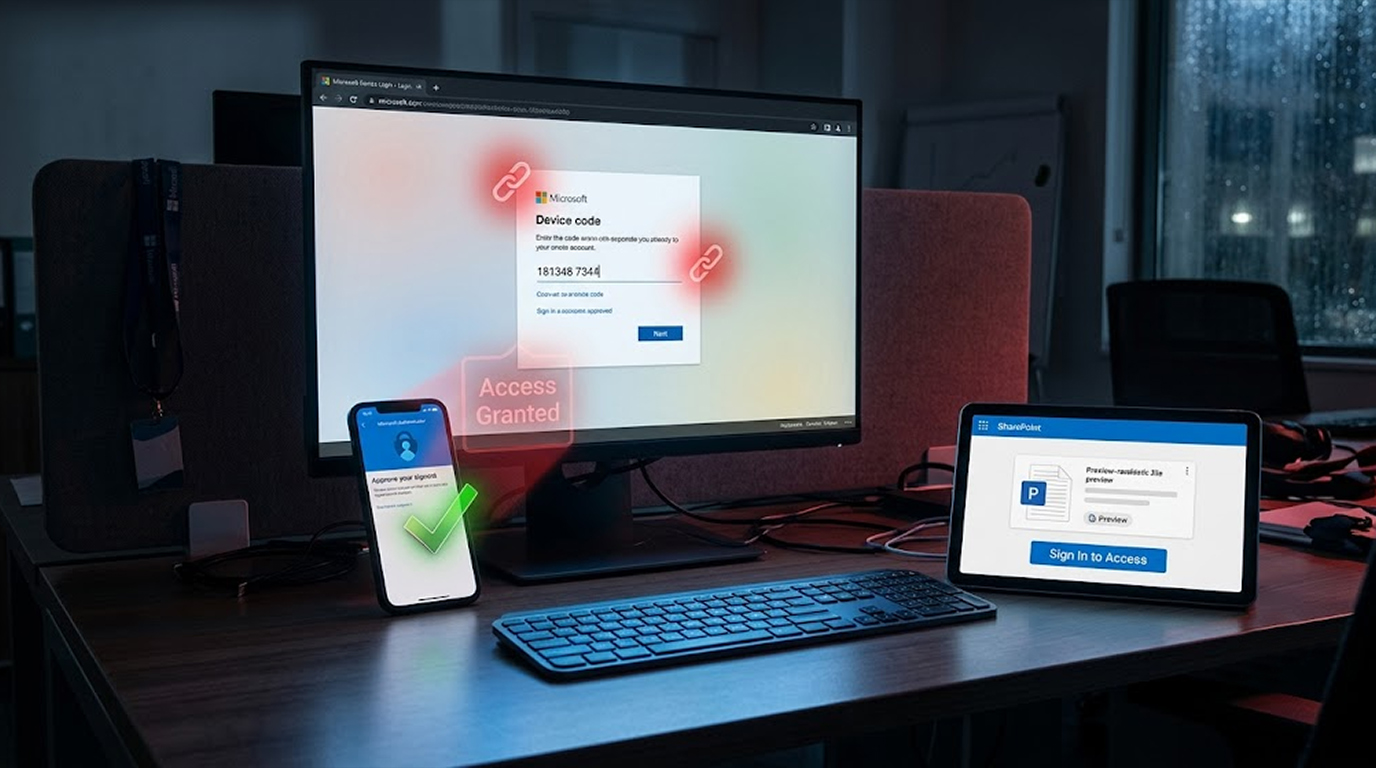
- First, the lure. The victim is shown a webpage mimicking a legitimate business service like SharePoint, OneDrive, or DocuSign. In one sandboxing scenario, for instance, the victim is lured by means of a SharePoint-themed lure into the authentication flow.
- Second, Microsoft authentication. The page redirects the victim to Microsoft’s legitimate device login portal and requests that the user enter a certain code which is provided by the attacker. The victim believes they are authenticating to access a legitimate service.
- Third, OAuth access. Once the victim finishes the authentication process, the attackers gain access to tokens which will grant them continued access to Microsoft 365 emails and files. This access might last a long time.
Kali365 is a dangerous phishing kit, because the victim actually authenticates into Microsoft's legitimate page. This activity may initially seem like an ordinary one, thus providing criminals with more time to abuse the credentials.
What the Kali365 Phishing Kit Can Cost a Business
A single approved device-code request can expand into a wider Microsoft 365 compromise. For US companies, the consequences of the Kali365 phishing kit may include several severe outcomes.
- Financial fraud is a primary concern. Compromised email accounts provide opportunities for manipulation of invoices, fraudulent payments, and email compromise scams. Payments can be intercepted through manipulation of emails.
- The exposure of sensitive information is yet another threat. The attackers may have access to corporate email, internal documents, customer information, and confidential information. These include the trade secrets and intellectual property, among others.
- Operational disruption is also possible. Unauthorized access to cloud services can interfere with daily communications and business processes. Critical business functions may be delayed or halted.
- Further higher costs will come from the responses to such an attack. Reduced phishing indicators make detection and containment more difficult. Incident response teams will have to work much harder in order to detect and fix the attack.
- Compliance and reputation issues will complete the list. In case of a compromise on the data that is covered by regulations, organizations may need to report on the incident.
Why the Kali365 Phishing Kit Is Hard to Detect
- The Kali365 phishing kit is difficult to detect because it abuses a legitimate authentication flow. The victim authenticates on Microsoft's real device login page. The phishing activity may not trigger traditional security alerts.
- The real warning signs often appear earlier in the lure, redirects, browser behavior, scripts, and attacker-controlled infrastructure. But these indicators may be missed by organizations that rely solely on email filtering and basic security controls.
- The Kali365 phishing kit cannot be addressed through email filtering alone. Security leaders need current campaign intelligence, faster validation of suspicious activity, and better preparation for how the threat may evolve.
Expanding Detection with Phishing Intelligence
The Kali365 phishing kit operators can rotate domains, URLs, and hosting infrastructure as campaigns evolve. Indicators from one confirmed case may quickly become outdated, leaving gaps across the rest of the environment.
Fresh phishing IOCs should reach SIEM, SOAR, TIP, firewalls, and other security controls where they can support alert enrichment, retrospective searches, and blocking decisions. ANY.RUN's Threat Intelligence Feeds deliver newly observed indicators through STIX/TAXII, API, and SDK.
The intelligence is drawn from sandbox investigations submitted by more than 15,000 organizations and 600,000 security professionals worldwide. Each IOC links back to the session where it appeared, giving defenders the full context needed to verify the threat and identify related Kali365 infrastructure.
Giving Analysts the Evidence Needed to Act
- As victims authenticate on Microsoft's legitimate device login page, the Kali365 phishing kit may look like normal activity at first. The real warning signs often appear earlier in the lure, redirects, browser behavior, scripts, and attacker-controlled infrastructure.
- The Interactive Sandbox uses both the hands-on approach and automation for detecting the entire attack chain quicker. These include the phishing page, redirects, network behavior, and moving towards Microsoft authentication.
- Auto-generated reports bring together the verdict, IOCs, TTPs, and behavioral evidence in a shareable format. This would enable Tier 1 to detect malicious activity earlier, to escalate more complicated incidents with additional context, and to facilitate quick containment prior to lateral movement through Microsoft 365.
Turning Threat Research into Proactive Defense
Kali365 phishing kit activity can be explored beyond a single alert by checking current campaign data in Threat Intelligence Lookup. The above results give some background regarding infrastructure that is associated with the threat group, sandboxing of the samples, lure screenshots, and targeting patterns.
In case of targeting in the US, queries can be conducted to get details about the Kali365 campaigns in the sectors of manufacturing, technology, healthcare, government, consulting, and Managed Security Service Providers.Defenders thus get a more accurate idea of the places where the campaign is being run and the domains and URLs associated with that campaign.
Threat Intelligence Reports provide an additional layer of preparedness. These reports are manually created by analysts and cover active malware and phishing campaigns, including APTs and cybercriminal organizations. Each report includes investigation findings and lookup queries that teams can apply to threat hunting, detection reviews, and incident enrichment.
The CISO Challenge
The Kali365 phishing kit puts pressure on a part of the security stack many organizations still treat as trusted by default: cloud authentication. The CISO challenge is to ensure the SOC can recognize when a legitimate login flow has been manipulated, trace the activity back to its source, and contain access before email, files, or business systems are affected.
Organizations using advanced threat intelligence platforms have reported measurable improvements. These include faster threat triage, reduced mean time to respond, lower Tier 1 workload, and fewer Tier 1-to-Tier 2 escalations.
They decrease costs of responding, ensure that the use of SOC resources that are already available is optimized, and minimize the window of opportunity for token abuse to turn into fraud, data breach, or disruption.
What Organizations Should Do About Kali365
The Kali365 phishing kit requires a multi-layered defense approach.
Organizations have three key areas to focus on:
- First, enhancing detection through phishing intelligence. IOCs need to be available in a timely manner for all security controls. The richer the context of the intelligence is, the better it will be for the defender.
- Second, give analysts the evidence needed to act. Interactive analysis and auto-generated reports help Tier 1 confirm malicious activity sooner and escalate complex cases with clearer context.
- Third, convert threat research into proactive defense. With existing campaign data and threat intelligence reports, it is possible for teams to detect patterns and prepare themselves before such patterns emerge in their own environment.
Wrapping It Up
The Kali365 phishing kit is a sophisticated token theft campaign targeting US organizations. It exploits the authentication process used by Microsoft to confirm that the devices are indeed valid. After obtaining the tokens, they allow access to Microsoft 365 emails, documents, and other online assets.
A Kali365 phishing kit could have some dire consequences. Some of the potential consequences include financial fraud, data breach, disruption, response cost, and reputation.
Protection against the Kali365 phishing attack tool goes beyond email filtering. There is a need for intelligence on the current status of threats, quick verification of suspicious activities, and proper preparations on how to respond if the threat evolves.
With the help of the right technology, SOC teams will be able to detect when a legitimate login flow has been manipulated and contain access before it escalates.
The Kali365 phishing kit is active and targeting US organizations. Defenders should take note and adjust their security posture accordingly.
FAQ Section
What is the Kali365 phishing kit?
Kali365 is a device code phishing kit that abuses legitimate Microsoft authentication. This involves the use of attacker-controlled device codes that are approved by victims through Microsoft’s authentic portal, which gives the attackers access to the access and refresh tokens.
What are the possible threats to Kali365?
The threats involve money laundering, exposing sensitive information, operational disruption, increased cost of response, compliance issues, and reputation risk. A breach in one account could be a larger business issue.
What are the potential impacts of a Kali365 breach?
The possible impacts include financial fraud, exposure of confidential information, disruption of the business operation, high cost of response, and non-compliance and reputation concerns. From one breach, a bigger business problem can ensue.
How can organizations detect Kali365 attacks?
Organizations need current phishing intelligence, interactive sandbox analysis, and context-rich IOC sharing. The real warning signs often appear in the lure, redirects, browser behavior, and attacker-controlled infrastructure before the authentication flow.
What should organizations do to defend against Kali365?
The attention should be paid to detecting threats by providing actionable phishing intelligence to analysts and converting threat research into defense. The training of users to detect suspicious authentication prompts is also important.