Can a Game Hack My Phone
You download a game, you play it, it works fine, and then you notice your battery is draining faster than usual, your data usage has jumped, and your phone is warm even when you are not using it.
So you start wondering whether the game did something to your phone, and the honest answer is more interesting than a simple yes or no, because the game itself is rarely the problem and the path you took to get it usually is.
Here is where the real risk actually sits.
Important Disclaimer
This article is intended for educational and defensive purposes only, and the information shared here is meant to help everyday users understand the risks in mobile gaming so they can protect themselves.
Do not use these techniques against systems you do not own or do not have explicit written permission to test, because unauthorized testing is illegal in most jurisdictions.
The author assumes no liability for any damages, legal consequences, or other outcomes resulting from the use or misuse of this information, so always use official sources and think before you grant permissions, and stay legal, stay ethical, stay responsible.
The Short Answer
A game installed from an official store, running on a patched phone, is very unlikely to hack your device in the traditional sense, because the store review process catches most obvious threats and the operating system sandboxes apps so they cannot freely reach into each other.
A game that you sideloaded from a third party site, that you got from a modded version of a paid title, that you installed to get unlimited coins, or that arrived as an APK in a group chat, is a completely different story, and those are where almost every real incident comes from.
So the question is not whether games are dangerous, the question is where you got it and what you gave it permission to do.
Risk 1: The Modded Game
This is the single most common way phones get compromised through gaming, and it is also the most avoidable.
What It Looks Like
You search for a popular game and you find a version that promises unlimited coins, unlocked levels, no ads, or a premium experience for free. The download comes from a forum, a file host, a Telegram channel, or a site that ranks well for the game's name plus the word mod.
Why It Is Dangerous
The modded version is a repackaged copy of the original, and someone has edited it, and you have no way to know what they changed.
Sometimes the changes are exactly what they promised and nothing else. Sometimes the mod includes a remote access tool, a credential stealer, a banking trojan, or a silent subscription that bills you every month.
The reason attackers love this channel is that you have already decided to bypass the official store, which means you have already lowered your defenses, and the install happens with your full consent.
The Real Cost
Modded games rarely cost money up front, and the cost appears later, and it appears in the form of stolen accounts, fraudulent charges, or a phone that behaves strangely for weeks.
Risk 2: The Fake Game Clone
This is the second most common risk, and it targets people who are looking for a specific game and find something that looks almost right.
What It Looks Like
You search for a game by name, and you find a listing with a nearly identical icon, a slightly different name, and a developer you have never heard of. The screenshots look plausible, the description reads like the real one, and the reviews are either missing or generic.
Why It Is Dangerous
The clone is often a vehicle for ad fraud, subscription fraud, or credential theft, and it usually asks for permissions the real game would never need.
A puzzle game does not need access to your contacts. A racing game does not need your SMS messages. A casual game does not need to read your call log.
When an app asks for permissions that do not match what it does, that is the signal.
Where It Shows Up
Clones appear in official stores too, which surprises people, because store review catches known malware but does not catch a new app that simply impersonates a popular title.
The clone may be removed eventually, and it may collect thousands of installs before it is.
Risk 3: The Malicious Ad Inside a Legitimate Game
This is the risk that catches people who did everything right, because the game itself is real, and the problem arrives through the ad network.
How It Works
Free games are supported by ads, and those ads are delivered through a network that the developer does not fully control, and sometimes a malicious creative gets into the rotation.
The ad can redirect you to a page that looks like a system warning, or it can open a pop up that claims your phone is infected, or it can serve a download that promises a cleaner or a booster.
The game is not malicious, and the ad is, and the delivery channel is the gap that most people do not think about.
What Makes It Effective
The ad appears inside an app you already trust, and it often mimics a system message, and it usually creates urgency, and those three things together are enough to make people tap.
The Defense
Do not tap ads, and if an ad claims your phone is infected, close the game and check your device yourself, because no legitimate ad will ever tell you that.
Risk 4: The Overlay Attack
This one is technical, and it is worth understanding because it is used in real campaigns.
How It Works
A malicious app draws an invisible layer on top of the screen, and when you tap what you think is a legitimate button, you are actually tapping the attacker's overlay.
This is used to grant permissions you did not intend to grant, to approve payments you did not intend to approve, and to capture input on screens that look like they belong to another app.
Why It Targets Gamers
Games are a good disguise because they are often full screen, they involve rapid tapping, and they sometimes ask for accessibility permissions for legitimate reasons, which makes a malicious request look normal.
The Defense
Be cautious with any app that asks for accessibility permissions, and check that permissions are being granted by a screen you actually recognize.
Risk 5: The Fake Currency Generator
This is social engineering more than malware, and it still works extremely well.
How It Works
You find a website or a social account that promises free in game currency, and it asks you to enter your game account credentials, and it may also ask you to complete a survey or download something to prove you are human.
Why It Is Dangerous
There is no currency, and there never was, and the credentials you entered are now in someone else's hands, and the survey is generating revenue for the attacker while you wait for nothing.
If the game account is linked to a payment method, the attacker may use it. If the same password protects your email, the attacker now has both.
The Defense
If a service is offering something for free that the game itself sells, it is a scam, and this is true every single time.
Risk 6: Excessive Permissions in Legitimate Games
Not every risk involves malware, and this one is about what you hand over without thinking.
What It Looks Like
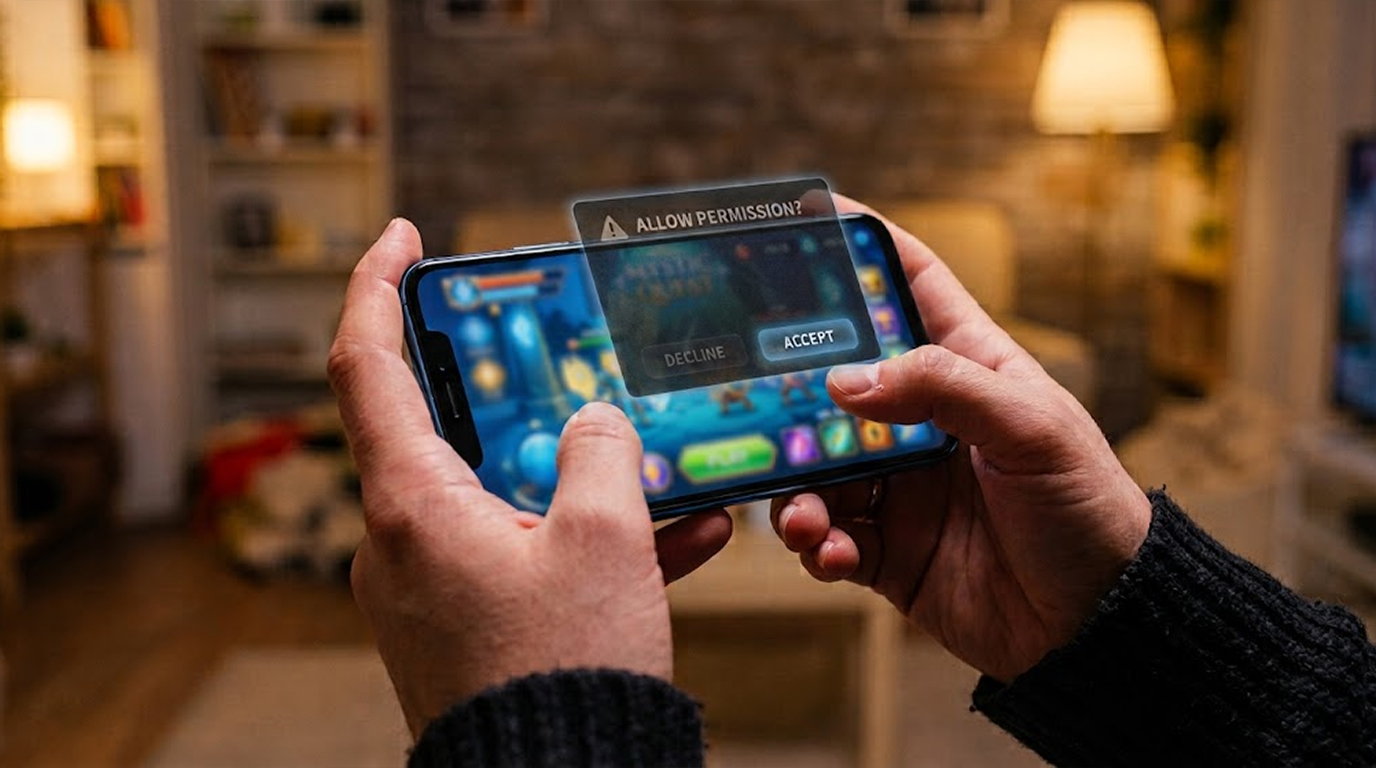
The game asks for access to your contacts, your photos, your microphone, your location, or your storage, and you tap allow because the prompt appears during setup and you want to start playing.
Why It Matters
Some of those permissions are legitimate. A game with voice chat needs the microphone. A game with photo sharing needs the gallery. A location based game needs location.
Others are not. A match three game does not need your contacts, and a single player adventure does not need your call log, and when the request does not match the function, the data is going somewhere it should not.
The Defense
Review permissions before you grant them, and if the request does not make sense for the game, deny it and see whether the game still works, because most of the time it will.
Risk 7: The Malicious SDK
This is the rarest risk in this list, and it is also the hardest to avoid, because it affects games that look completely legitimate.
How It Works
Developers build games using third party software development kits for ads, analytics, payments, and social features, and occasionally one of those kits contains malicious code or behaves in ways the developer did not intend.
The game itself is not malicious, and the developer did not intend harm, and the malicious behavior arrives through a dependency the developer trusted.
Why It Matters
It means that "I got it from the official store" is not an absolute guarantee, and it explains why even careful users sometimes end up with apps that misbehave.
The Defense
Keep your operating system updated, review app permissions, and uninstall anything that starts behaving strangely, because the platform level protections are your main line of defense here.
Real Scenarios
Scenario 1: The Unlimited Coins Download
The Setup
A player wants to progress faster in a popular game, so they search for a modded version that offers unlimited currency.
The Attack
The download comes from a file host, and the installer asks for accessibility permissions to enable the mod features, and the player grants them.
The Result
The app functions as promised for a few days, and then starts displaying ads on top of other apps, and eventually the player notices unauthorized charges on a linked payment method.
The Lesson
The promised feature was real, and so was the malware, and the permissions request was the moment the risk became concrete.
Scenario 2: The Clone in the Store
The Setup
A player searches for a game they heard about, and they install the first result, which has a similar name and a familiar looking icon.
The Attack
The app asks for access to SMS and contacts, which the player grants because they assume it is part of the game.
The Result
The app is a subscription trap, and the SMS permission is used to intercept one time verification codes, and the account is compromised within hours.
The Lesson
The store does not guarantee safety, and permissions are the clearest signal that something is wrong.
How to Stay Safe
The defense is simple, and it does not require any technical skill.
1. Only Download from Official Stores
Only use App Store, Google Play, or the manufacturer’s trusted store, and consider anything else a decision to take a risk rather than a convenience.
2. Never Enable Unknown Sources Unless You Have a Specific Reason
That setting exists for developers and testers, and for everyone else it is a door that stays closed.
3. Never Install Modded or Cracked Games
The feature you want is the feature the attacker is using to get in, and the trade is never in your favour.
4. Read the Permission Request Before Tapping Allow
If a game asks for something that does not match what it does, deny it, and see whether the game still works.
5. Do Not Tap Ads
If an ad claims your phone is infected, close the game and check your device yourself, and never download anything an ad offers you.
6. Ignore Free Currency Offers
They are scams, they have always been scams, and they will continue to be scams.
7. Review Your Installed Apps Periodically
Look for apps you do not recognise, apps you no longer use, and apps with permissions that do not make sense.
8. Keep Your Phone Updated
Platform updates close the vulnerabilities that malicious apps exploit, and they also improve the permission controls.
9. Use a Standard User Account Where Possible
Do not root or jailbreak your primary device unless you genuinely need to, because it removes protections that would otherwise contain a bad app.
10. Watch for Behaviour Changes
Battery drain, unexpected data usage, ads appearing outside of apps, and a phone that runs warm while idle are all worth investigating.
Quick Reference: Mobile Gaming Safety Checklist
|
Habit |
Why It Helps |
|
Official stores only |
Store review catches most obvious threats |
|
No unknown sources |
Closes the main sideloading path |
|
No modded games |
Removes the most common delivery channel |
|
Check permissions |
Mismatched requests are the clearest signal |
|
Do not tap ads |
Ads are a delivery channel inside trusted apps |
|
Ignore free currency offers |
They are always phishing |
|
Review installed apps |
Catches forgotten and unrecognised software |
|
Keep the phone updated |
Closes exploitable platform flaws |
|
Avoid rooting |
Preserves platform protections |
|
Watch behaviour changes |
Early detection limits damage |
The Bottom Line
A game installed from an official store, running on a patched phone, is very unlikely to hack your device, and a game you sideloaded to get unlimited coins is a completely different risk profile, and almost every real incident sits in the second category.
The threats are not exotic. They are modded games, fake clones, malicious ads, overlay attacks, free currency scams, and permission abuse, and each one depends on you making one decision that the attacker is counting on.
Skip the mod, check the permissions, ignore the ads, and never take the free currency, and you remove almost all of the risk.
The game is usually fine. The path you took to get it is where the trouble lives.
FAQ Section
Can a game from the official store hack my phone?
It is very unlikely, because store review catches most obvious threats, though malicious code can occasionally arrive through a compromised third party component.
Are modded games safe?
No, because you have no way to know what was changed, and the feature you want is often the cover for something else.
Can a game steal my banking details?
A malicious game can overlay a fake login screen on top of your banking app, or it can capture credentials through a phishing page, so the risk is real when the game came from an untrusted source.
What permissions should a game never need?
A game should not need your contacts, your SMS messages, or your call log unless it has a specific feature that genuinely requires them.
What should I do if I installed a suspicious game?
Uninstall it immediately, revoke any device administrator access it was granted, run a security scan, and change any passwords you entered while it was installed.
Do free games with ads put me at risk?
The game itself is usually fine, but ads are a delivery channel, so do not tap them and do not download anything they offer.