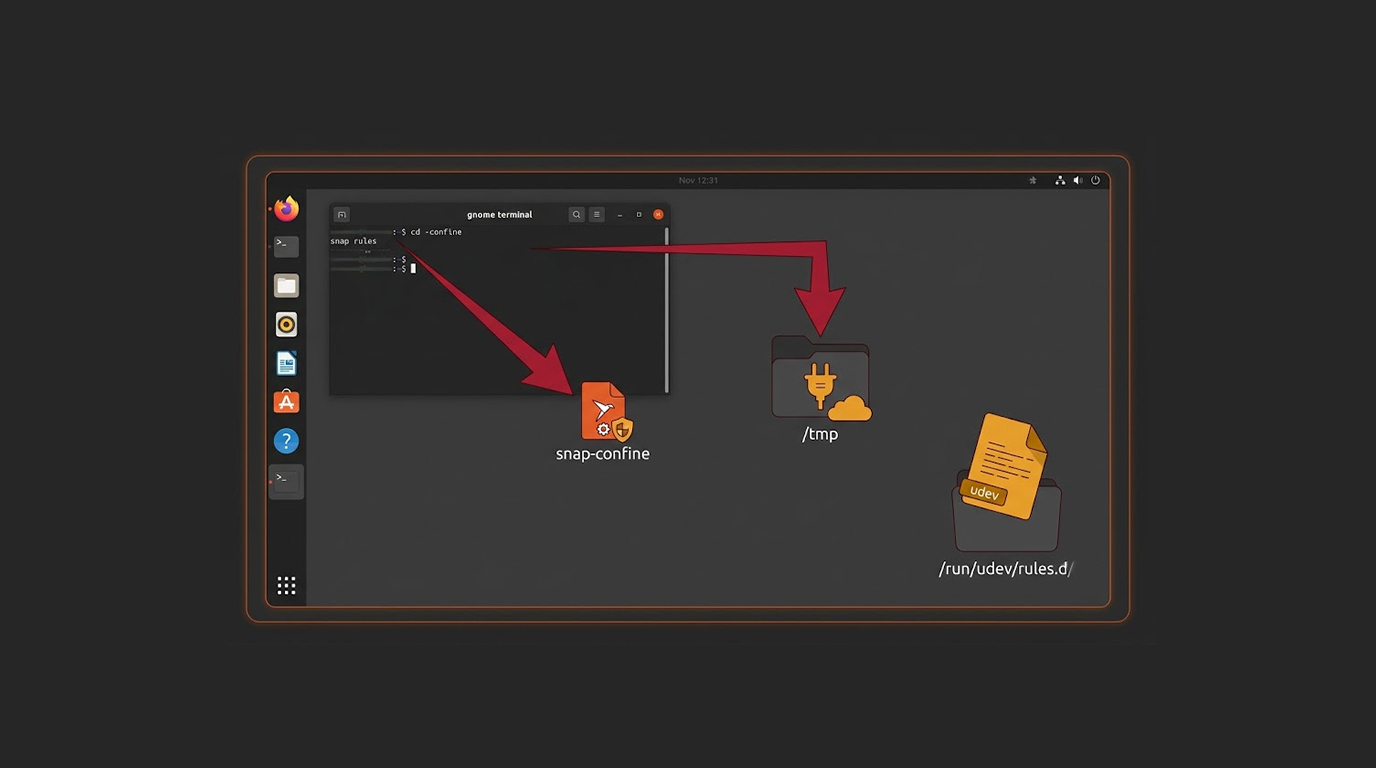
There is a local privilege escalation vulnerability in the snap-confine which lets an unprivileged user gain root permissions and full control over a targeted system. The vulnerability is reported by the CVE number CVE-2026-8933 and it impacts the default configuration of Ubuntu Desktop 24.04, 25.10, and 26.04 systems.
The vulnerability results from a security hardening mechanism which unintentionally causes a race condition while initializing a sandbox. The CVSS score for this vulnerability is 7.8.
What Is Snap-Confine?
Snap-confine is an internal program of snapd and offers the environment within which snap applications run. Snapd is a back end system that manages snap packages in Linux based operating systems.
Snaps are a software packaging format devised by Canonical that allows applications to run securely in an isolated sandbox across most Linux distributions.
Snapd runs a sub-process called snap-confine, which is responsible for creating the necessary confinement for the snap.
The Hardening Change That Went Wrong
Recent Ubuntu releases use the set-capabilities model to enforce the principle of least privilege. This is meant to minimize the attack surface. Nevertheless, snap-confine can be executed using the effective UID of the caller yet maintaining almost root-like permissions.
When preparing a sandbox, snap-confine creates some directories and files in the /tmp directory with the owner of the unprivileged user. Then ownership is changed to root almost immediately, but there is a small time period where the caller has full access to the file.
Two Concurrent Race Conditions
The snap-confine local privilege escalation flaw is the result of two concurrent race conditions:
- FUSE mount bypass: An attacker mounts a malicious FUSE filesystem over the temporary scratch directory immediately after creation. In this way, the attacker manages to bypass the isolation provided by the mount namespace isolation by snap-confine and access the directory from the outside of the sandbox environment.
- Sym-link attack: The attacker creates a sym-link that points to a target file of his/her own choice.
By using the permissions manipulation technique, the attacker is able to inject malicious rules into the system directory and get root code execution.
The udev Rules Injection Attack
As part of the exploitation process for evading AppArmor restrictions, the target is chosen to be the /run/udev/** directory, which allows read/write permissions. This is accomplished by dropping a malicious .rules file in /run/udev/rules.d/ and cycling through mount and unmount operations using FUSE.
Who Is Affected?
The snap-confine local privilege escalation flaw affects default installations of Ubuntu Desktop 24.04, 25.10, and 26.04. An attacker still needs user-level access or code execution, but the flaw can turn that foothold into full control of the host.
Ubuntu 24.04 is notable because updated systems can carry the affected snap-confine variant. Administrators must verify the installed snapd version instead of relying on release age or prior patch status.
The Fix
Organizations must apply the latest snapd updates as soon as possible. With fixes available, rapid deployment and confirmation should take priority.
A Pattern of Snap-Confine Vulnerabilities
This is not the first time security flaws have been uncovered in snap-confine. In February 2022, Qualys detailed another local privilege escalation flaw dubbed Oh Snap! More Lemmings (CVE-2021-44731).
This vulnerability can be exploited in order to obtain root privileges via exploitation of the race condition in snap-confine’s setup_private_mount().
Following that, more vulnerabilities have been found, such as CVE-2022-3328 and CVE-2026-3888.
The Bottom Line
The snap-confine local privilege escalation flaw is a serious vulnerability affecting default Ubuntu Desktop installations. A race condition, a FUSE mount bypass, and a symlink attack combine to give an unprivileged user root access.
Apply the latest snapd updates immediately. Verify your installed version. And treat every employee workstation, developer system, and administrative endpoint as part of the response scope.
FAQ Section
What is CVE-2026-8933?
It is a flaw that exists in snap-confine and results in local privilege escalation whereby an unprivileged user gains root access to the system.
Which versions are affected?
Ubuntu Desktop 24.04, 25.10, and 26.04 are affected. Updated systems can carry the vulnerable snap-confine variant.
How is the exploit working?
This exploit exploits a race condition during the sandbox initialization process. The attacker creates a malicious FUSE file system by creating a symlink to redirect the files.
What is the udev rules injection?
An attacker places a malicious .rules file into /run/udev/rules.d/ directory, and thereafter the attacker runs arbitrary commands via systemd-udevd.
What should I do?
Update your snapd to the most recent version. Verify your installed snapd version. Prioritize employee workstations, developer systems, and administrative endpoints.
Has this happened before?
Yes. Qualys previously disclosed Oh Snap! More Lemmings (CVE-2021-44731) and other snap-confine vulnerabilities have been found since.