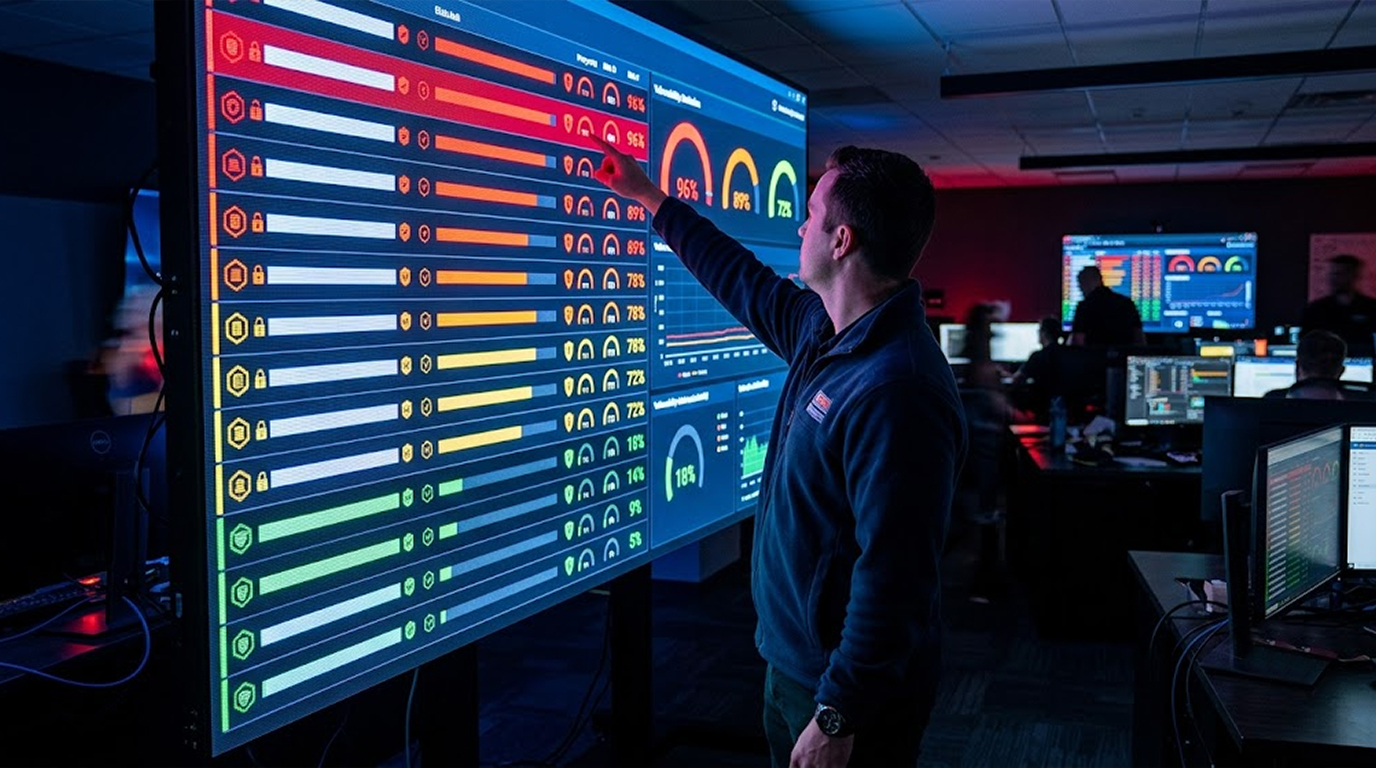
You have 40,000 new vulnerabilities reported in a single year. Your security team can realistically patch maybe 5% of them. The rest will sit there, unpatched, waiting.
The question is not "which vulnerabilities exist?" The question is "which ones will actually hurt us?"
Traditional scoring systems like CVSS tell you how bad a vulnerability could be. But CVSS doesn't tell you whether anyone will actually exploit it. That's a completely different question.
Enter AI-driven risk scoring. It is not about theoretical severity. It is about predicting real-world exploitation probability. And it is changing how security teams prioritize their work.
Let me show you how this works in practice and what tools you can use right now.
The Problem with Traditional Scoring
You have probably used CVSS scores. A vulnerability gets a number from 0 to 10. Anything above 7 is "high" or "critical." You patch those first. Simple, right?
Not really. Vulnerabilities labeled as "critical" are often never exploited, while serious incidents have originated from vulnerabilities scored as "medium" or "high."
The problem is that CVSS measures theoretical severity. It asks: "If this vulnerability were exploited, how bad would it be?" It does not ask: "Is anyone actually going to exploit this?"
That second question is the one that matters. And that is where AI comes in.
How AI-Driven Risk Scoring Works
AI risk scoring models take a fundamentally different approach. They predict the likelihood of real-world exploitation.
The inputs are different.
Instead of just looking at CVSS vectors, these models ingest multiple data sources. Public vulnerability databases. Exploit availability signals. Temporal patterns. Proof-of-concept releases. Known exploited vulnerability catalogs. Even threat intelligence feeds and forum chatter.
The models are different.
Machine learning classifiers, deep learning architectures, and even large language models are being used to predict exploitation likelihood. Some models are extremely good at distinguishing between vulnerabilities that will be exploited and those that will not.
The outputs are different.
Instead of a single severity score, you get an exploitation probability. A ranking of vulnerabilities by real-world risk. An explanation of why the model made its prediction.
The Exploit Prediction Scoring System (EPSS)
The Exploit Prediction Scoring System is one of the most widely deployed vulnerability prioritization models in the industry. It is part of security products and employed by organizations in all industries.
EPSS predicts the likelihood that a vulnerability will be exploited in the wild within the next 30 days.EPSS does not provide an assessment of the severity of the vulnerability; rather, it provides a probability rating between 0 and 1.
What this means in practice:
A severity-based approach, such as remediating every vulnerability with a CVSS score of 7.0 or higher, can force organizations to act on more than half of all published vulnerabilities. EPSS lets teams cover comparable or greater risk with a much smaller remediation burden.
The CISA Known Exploited Vulnerabilities (KEV) Catalog
The CISA KEV catalog is an authoritative source of vulnerabilities that have been confirmed as actively exploited in the wild. It is not a prediction. It is a confirmation.
What it contains:
Vulnerabilities with an assigned CVE ID, reliable evidence of active exploitation, and clear remediation action.
How to use it:
CISA highly advises that all organizations consider remediation of identified vulnerabilities from the KEV list a priority. This list is a basis for any vulnerability management prioritization process.
Practical Open-Source Tools
Tool 1: NVD combined with EPSS
What is it: The National Vulnerability Database (NVD) gives you a list of vulnerabilities which have CVEs, CVSS scores, descriptions, and references. You can export this list and include the EPSS scores in your database.
How to use it:
- In the first step, the list of CVE needs to be obtained from NVD.
- The query can be provided to EPSS, and the EPSS scores of the CVE can be obtained.
- All the CVEs need to be sorted as per EPSS scores.
- Another criterion here is KEV status.
Tool 2: EPSS API
What it is: EPSS API allows the user to fetch the EPSS score via programming.
How to use it:
- Get results from EPSS through the CVEs.
- Get EPSS score and percentile of all CVEs.
- Filter out the vulnerabilities according to the above criteria.
Tool 3: EPSS-CLI
What is it: Command line interface tool that provides EPSS score and KEV status of the particular CVE in Linux OS.
How to use it:
epss-cli CVE-2021-40438
Provides CVSS Base Score, CVSS Vector, CVSS Severity, EPSS Score, EPSS Percentile, and KEV status.
Advantages: Very quick, very scriptable, fits the DevOps flow perfectly. Can be used in the CI/CD pipeline to avoid deploying the vulnerable code.
Tool 4: SecurityScorecard
What it is: It is a commercial tool which makes use of the EPSS scores in its Vulnerability Intelligence system.
How to use it:
The SecurityScorecard Vulnerability Intelligence system comes with EPSS scores which means that there will be an ability to predict the risk of exploitation.
Tool 5: NVD with EPSS & KEV Integration
What it is: This is an enhanced NVD tool that provides EPSS scores and KEV status in addition to CVSS scores.
How to use it:
Sort the list of your vulnerabilities using EPSS score, KEV status, and CVSS scores. The top priority should go to vulnerabilities that are KEV followed by the ones with high EPSS score. Lastly consider CVSS scores.
Practical Implementation Steps
Step 1: Feed the model.
In order to create and implement vulnerability risk scoring models using artificial intelligence techniques, we require data. Provide the data set which contains all the vulnerabilities as well as external variables like exploits and threat intelligence.
Step 2: Vulnerability Scoring.
The model takes as input the list of vulnerabilities. Assign a probability score to each one. Start with the highest probability vulnerabilities first. Patch those.
Step 3: Develop tiers.
It is important not to consider only one score but develop risk tiers based on the scores.
Step 4: Establish thresholds.
Do not decide that all vulnerabilities with a CVSS score of 7.0 or higher will require patches. Establish thresholds based on exploitation probabilities, because a critical vulnerability with a low probability of exploitation can take second place behind a medium vulnerability with high probability.
Step 5: Evaluate and improve.
Initially your model will never be absolutely accurate. You need to analyze exploitation events and adjust weights or thresholds in the model accordingly.
Real-World Scenario: The Two Vulnerabilities
Scenario:
Two vulnerabilities are reported by your security team on the same day.
Vulnerability A is ranked at 9.8 (critical) on the CVSS scale, and affects the software operating in your publicly facing web server. There are no known exploits, proof of concept, and discussions on the dark web about this vulnerability.
Vulnerability B is ranked at 6.5 (medium) on the CVSS scale and affects an older version of a library in your internal CRM system. Exploits for this vulnerability can be found on Github, proof of concept available, and discussions ongoing on the underground forums.
Traditional approach: Exploit Vulnerability A Since this vulnerability ranks high on the CVSS scale, you will need to spend considerable time exploiting your web server. However, Vulnerability B is still unpatched.
AI-driven method: According to the risk assessment scoring done through artificial intelligence, Vulnerability B is likely to be exploited since it is an exploit with a forum discussion; while Vulnerability A is unlikely to be exploited due to the non-existence of exploits for it.
The result: You stopped a real attack before it happened. The web server vulnerability was never exploited. The CRM vulnerability would have been.
The EPSS Workflow in Practice
Step 1: Export your vulnerability list.
Get a list of all vulnerabilities in your environment.
Step 2: EPSS Score Enrichment
Assign EPSS score to your vulnerabilities using the EPSS API.
Step 3: Rank based on EPSS and asset criticality.
Rank vulnerabilities according to EPSS score. That means multiplication of the EPSS vulnerability score with the asset criticality.
Step 4: Make a report
Compile a report with ranked vulnerabilities that need to be fixed and also a time frame for their remediation.
Step 5: Patch them sequentially.
Patch those ranked as being of highest priority first and then track your remediation efforts.
The Bottom Line
AI-driven risk scoring represents a fundamental shift in vulnerability management. Instead of asking "how bad is this vulnerability?" you ask "will this vulnerability actually be exploited?"
The tools are available. EPSS is mature and integrated into many security products. Open-source tools let you implement AI-driven risk scoring without starting from scratch.
The ROI is clear. You patch fewer vulnerabilities but prevent more real attacks. You stop chasing theoretical risks and start addressing actual threats.
The data is there. The models are there. The only question is whether you will use them.
FAQ Section
What is AI-driven risk scoring?
It is the use of machine learning models to gauge the probability of a vulnerability being exploited. This scoring system prioritizes vulnerabilities according to their risk levels rather than severity.
How does AI-driven risk scoring differ from CVSS?
The CVSS is an indicator of the severity of a particular vulnerability. However, the AI-driven risk scoring gives the probability of exploitation of the vulnerability. This means that one can be very severe but unlikely to be exploited.
What is EPSS?
Exploit Prediction Scoring System (EPSS) is one of the most popular models that predict how likely a certain vulnerability will be exploited. EPSS can be found in various security solutions and is available as a standard open-source tool.
What is the CISA KEV catalog?
CISA Known Exploited Vulnerabilities catalog contains all vulnerabilities that were detected as being actively exploited in the wild. It is an authoritative source for prioritizing remediation.
How do I begin implementing the risk scoring by using AI?
It is recommended to use EPSS scores to prioritize your already existing list of vulnerabilities. Most vulnerability management platforms provide integration with EPSS. You can use the EPSS API or EPSS-CLI to enhance your vulnerabilities with EPSS scores.