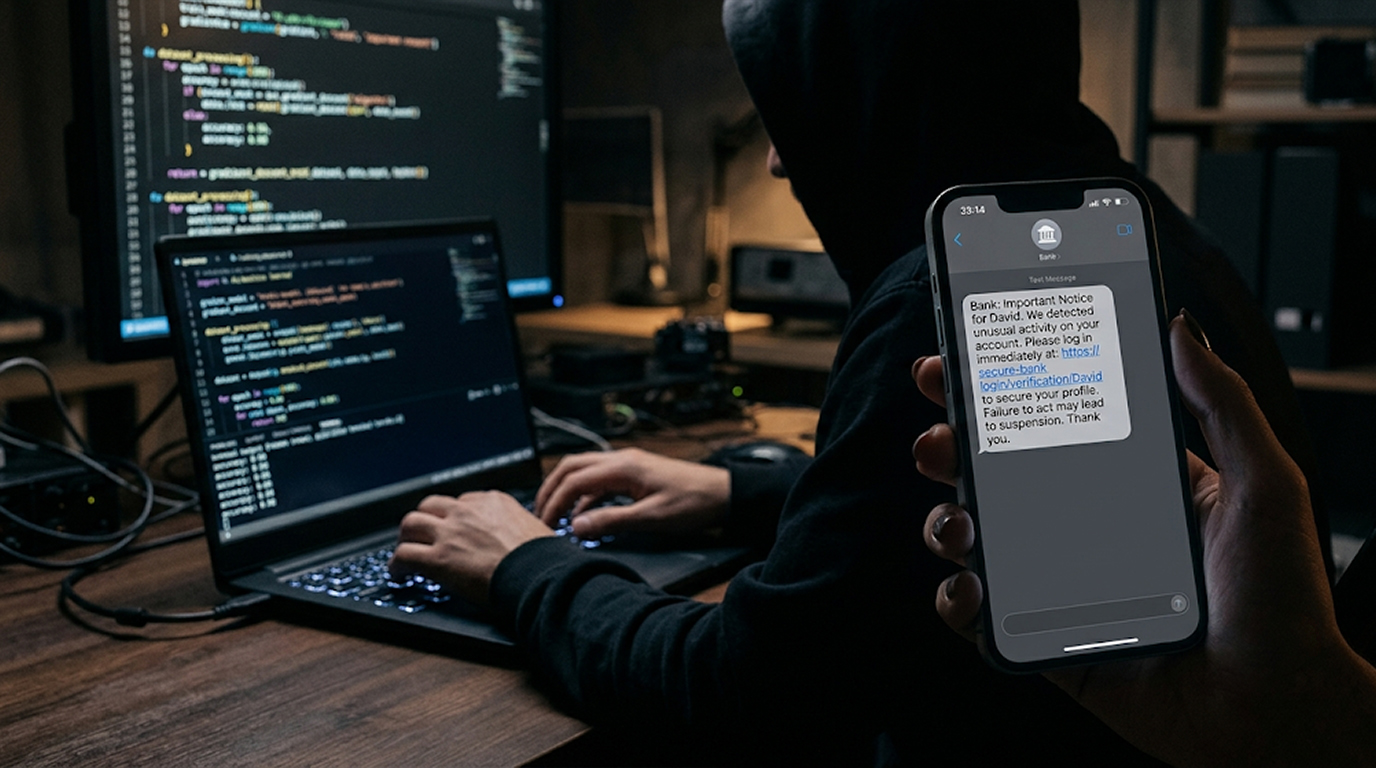
Your phone buzzes. A text message appears. It's from your bank or so it seems. The message is perfectly written. No typos. No awkward phrasing. It even knows your first name and the last four digits of your account.
You feel a wave of panic. Your heart races. You click the link without thinking.
Congratulations. You just walked into a trap.
This is not a coincidence. This is an AI-powered spam operation, and it is one of the most sophisticated scams in history. Attackers are using generative AI to send text messages that are nearly indistinguishable from legitimate communications.
They are not just blasting random messages. They are personalizing them, automating them, and scaling them in ways that were impossible just a few years ago.
Let me show you how these operations work, why they are so effective, and how to protect yourself.
The Day Spam Got a Brain
Remember the old spam emails? The ones with terrible grammar, weird formatting, and promises of millions from a Nigerian prince? Those were the good old days. At least you could spot them from a mile away.
Today, spam has evolved. It has a brain now. And it knows more about you than you think.
The difference is staggering:
Old spam was written by humans who often did not speak English as their first language. The messages were generic and full of errors.
AI spam is written by models trained on billions of examples of legitimate text.
The messages are perfect, personalized, and designed to exploit your emotions.
Old spam was sent to millions of people with the same message. AI spam knows your name, your location, your bank, and sometimes even your recent purchases.
Old spam was static. The message was the same every time. AI spam is dynamic. It adapts based on your responses, keeping you on the hook longer.
They are not just sending texts. They are running psychological operations on your phone.
Anatomy of an AI Spam Attack
Step 1: Gathering Information on the Target
Data gathering is the first step in an AI spam attack, and the information can be gathered through data breach, public records, social media, and purchase lists.
Data that is gathered:
Full name, phone number, email address, and address. Name and type of bank accounts. Recent transactions. Social media information.
The more data they have, the more convincing the messages. And let's be honest your data is already out there. It's just a matter of who buys it first.
Step 2: Personalization
All of these data are entered by the attacker in an AI tool to generate individualized messages for each target.
Not personalizing: "There is something very unusual going on with your account. Can you verify?"
Personalization used: "John, we have seen some unusual activity in your Chase Bank account with end number 6789.Please verify your identity to prevent a hold on your funds."
One of these messages you delete. The other one gives you a heart attack.
Step 3: Automation
The attacker uses automated systems to send the messages. These systems are able to transmit thousands of messages every minute.
The infrastructure:
SMS gateways through which messages go via several different carriers. Virtual numbers that cannot be traced easily. Proxy networks that hide the origin of the messages.
They are not working harder. They are working smarter.
Step 4: Responding to the Reply
Should the receiver answer the message or click the link in the message, then the AI will respond to the reply by answering any questions that the victim may ask.
Victim: "Is this actually Chase?"
AI: “Yes, this is the Chase Fraud Department. There has been some suspicious activity on your account. Click on the link to verify your identity.”
You are not talking to a human. You are talking to a machine that was built to manipulate you.
The Toll-Free Number Trap
Attackers are also using toll-free numbers to make their messages look more legitimate. A toll-free number with a recognizable name like "Chase Bank" or "FedEx" appears on your caller ID.
The message tells you to call the toll-free number to resolve your issue. When you dial the number, however, you are put through to a telephone-based AI system which mimics a customer service phone line.
AI phone system:
It requests that you give your account number, Social Security number, and other private information. It may even transfer you to a human scammer if it detects that you are a high-value target.
It is not just texts anymore. It is a full-scale operation.
How Attackers Get Your Number
Attackers have several ways to collect phone numbers for spam campaigns.
Data breaches are the most common source. In case of a corporate breach, phone numbers may be made public. Cybercriminals purchase the data from the dark web.
Public documents may also be used as a source for such information. Phone numbers may be public record through business directories, property records, and voter registration.
Social media has also become a new source. Phone numbers are listed on many social media accounts by individuals.
Phone numbers can be purchased from data brokers in bulk. Data brokers collect data from different sources and offer it for sale.
Phishing is also used. Attackers send messages that ask for your phone number, pretending to be a legitimate service.
Your number is out there. The question is who is using it.
What the Messages Look Like
AI-powered spam messages are designed to look like legitimate communications.
Bank Scam:
"Chase Alert: We detected unusual activity on your account ending in 6789. Please confirm your identity within 24 hours to avoid a hold. [link]"
Delivery Scam:
"FedEx: Your delivery has been delayed due to an error in your address. Please update the shipping information."
Government Scam:
"IRS: You have qualified for a tax rebate of $1,234. Please complete the verification process to claim your funds. [link]"
They are not just guessing. They are targeting you specifically.
Why This Works So Well
- It is personalized. The scam message knows all about your name, your bank, and even the account numbers.
- It is very well-written. There are absolutely no grammatical mistakes, and it is well-structured. Nothing suspicious.
- It causes an urgent reaction. You need to respond fast, without any critical thinking.
- It looks real. The link often goes to a page that looks exactly like the legitimate website.
- It is automated. The attacker can send thousands of messages without human effort.
They are not hoping you fall for it. They are counting on it.
How to Protect Yourself
- Do not click links in text messages. If you receive a message from your bank, do not click the link. Open your browser and type your bank's website address directly.
- Verify the source. The scammer may provide a phone number of an apparently genuine, but in reality, fake source.
- Avoid calling the number provided by the scammer. If the email instructs you to call a particular number, do not call that number. Instead, verify the number of the company’s customer care department on its official website.
- Exercise caution with urgency. Scammers make people feel rushed in order to prevent them from being able to think clearly.
- Use two-factor authentication. Even if a scammer gets your password, they cannot access your account without the second factor.
- When in doubt, throw it out. If you are not sure, delete the message. It is better to be safe than sorry.
What to Do If You Fall for It
If you have already clicked a link or provided information, take these steps:
- Contact your bank immediately.
- Change your passwords.
- Freeze your credit.
- Report the scam to the authorities.
Do not wait. Every second counts.
The Bottom Line
AI-powered spam is not going away. It is getting better. The messages are more convincing, the personalization is more accurate, and the automation is more scalable.
Red flags such as poor grammar and scams won’t be of much help in this case. It is imperative that you be suspicious of all messages, regardless of how credible they may seem.
Never click links. Never call numbers in messages. Never provide personal information in response to a text. Verify everything through official channels.
The attackers are using AI. You need to use common sense.
The next text you receive could be a trap. Do not fall for it.
FAQ Section
How do spammers get my phone number?
Spammers obtain your phone number using various sources such as data breaches, publicly available data, social networking sites, data brokers, and phishing scams. In case you have ever entered your phone number on any website, then it is likely that spammers have it.
How can I tell if a text message is AI-generated spam?
AI-generated spam is often perfectly written and personalized. It could contain your name, bank details, or even recent purchases that you have made. If the message contains an urgent appeal asking you to click the link provided or call the provided number, then it is surely a scam.
Can spam messages that use artificial intelligence technology steal my information?
Yes. The spam messages are meant to lure you into clicking the harmful links or calling the fake numbers or giving out your personal details.
What should I do if I receive a suspicious text message?
Do not click on the link, call the phone number, or respond. Delete the email. If it purports to be from an authentic company, contact the company using the number or site that is listed on the company’s site.
Is there anyway to block AI-spam emails?
You cannot block all AI-spam, but you can minimize them by using spam filtering applications and being careful whom you give your phone number to.