The trends described here are already visible in 2026. By 2027, they will be the new normal. This is not a prediction. It is a warning.
You are a CISO preparing a board presentation. You need to explain why your security budget is increasing. You have the data: phishing attacks are up, ransomware is getting worse, and compliance requirements are multiplying.
But the board wants to know what is different. Why is 2027 different from 2026? Why is this time different from the last five years?
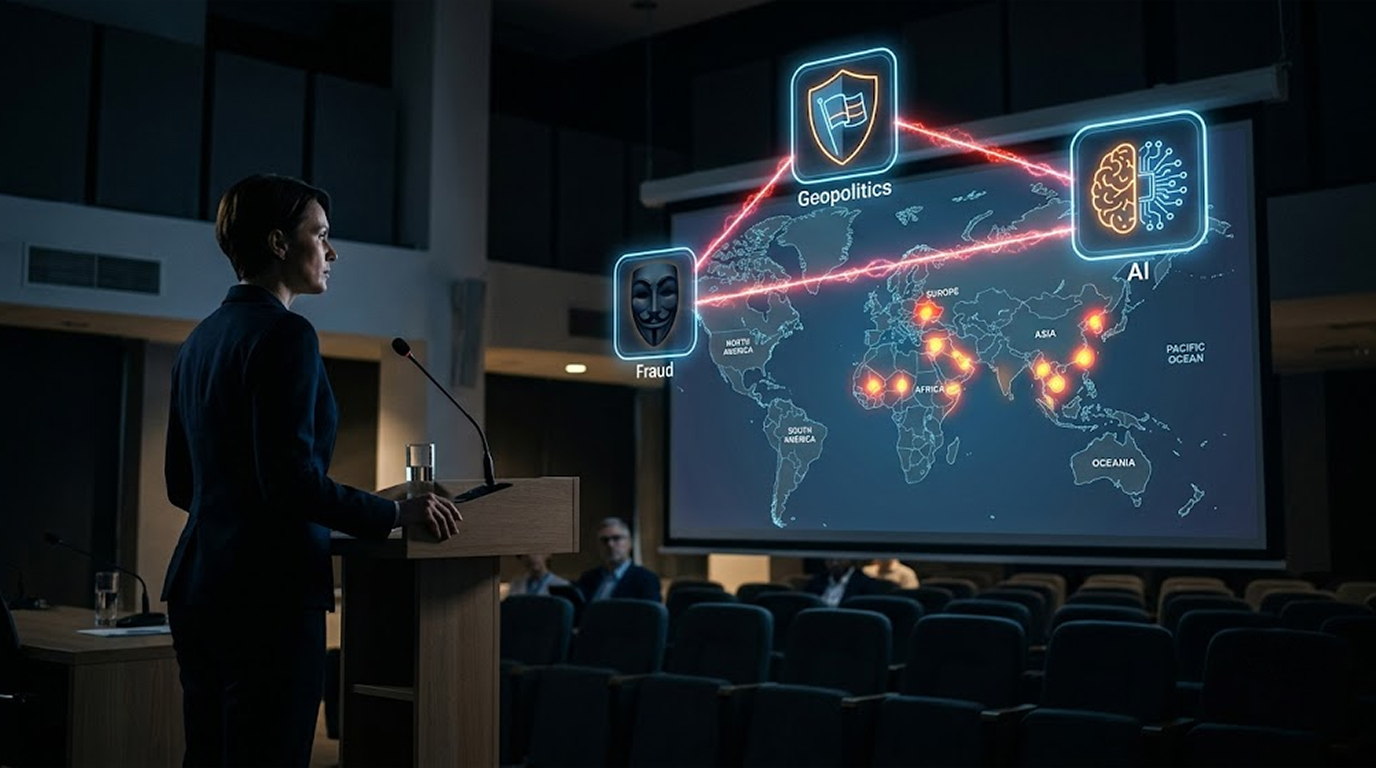
The answer lies in three converging forces. They are not independent trends.
They are feeding each other, accelerating each other, and creating a security landscape that is fundamentally different from anything we have seen before.
Geopolitics is fragmenting the digital world. AI is weaponizing deception at scale. Fraud is becoming industrialized and automated.
These three forces are not just reshaping security. They are transforming the ways of doing business, governance, and establishing trust in cyberspace.
Let me explain these forces and their interaction as well as what is expected from you regarding them.
Three Forces
Force 1: Geopolitics – The Erosion of Trust
There is fragmentation in the global digital spheres. Countries have different sets of laws, policies, and standards for the use of data and AI. Actions that may be acceptable in one country will be illegal in another. It is becoming difficult for multinational entities to ensure that they remain compliant.
There is competition between nations to establish capabilities in the use of AI in cyber operations. They are using AI in evading sanctions, intelligence gathering, and influencing elections. The economic aspect of cyber crime and warfare is growing beyond what was experienced before.
The erosion of trust in digital identity is increasing. The threat actors are using the AI technology to create more realistic imitations and bots. They are creating artificial voices, faces and adding false identities into the system When you cannot verify the business or person with whom you are dealing, what kind of negotiation is possible?
Geopolitical fragmentation is also creating a fragmented internet. There will be different requirements placed on each region regarding data storage, transfer, and content moderation. Fragmentation creates barriers for defenders to collaborate and share threat intelligence.
Force 2: AI – The Acceleration of Deception
The use of AI is not only complicating the attacks. It is making them more scalable, more automated, and more personalized than ever before.
The distinction between AI-assisted and AI-enabled attacks is critical. AI-assisted attacks use AI for discrete tasks: writing a better email, producing a cleaner document, generating a stronger false profile. AI-enabled attacks are more serious. They begin to coordinate the system itself. They link identity, documents, ownership structures, payment routes, cloud access, API calls, and timing.
The difference is not whether AI helps someone fake a document. The difference is whether AI begins to orchestrate the deception.
Generative AI is democratizing access to sophisticated offensive capabilities. Phishing attacks have soared because of generative AI systems, which can create deepfakes, voice cloning, automatic social engineering operations, and polymorphic malware that changes its behavior constantly to defeat defense mechanisms.
The world of AI disinformation is at a pivotal inflection point. It is projected that AI disinformation systems will enjoy an unassailable edge over any mitigation system in place by 2027, resulting in an asymmetric threat that cannot be addressed individually by any country or institution.
Multiple technical domains have crossed the detection horizon beyond which automated or human verification becomes statistically unreliable.
Offensive AI can learn across the ecosystem. It can scrape open information, reuse leaked records, study enforcement patterns, test onboarding forms, watch court filings, and probe compliance thresholds, then refine its behavior.
Defenders, by contrast, are hemmed in by privacy rules, fragmented data, explainability requirements, jurisdictional boundaries, and siloed technology estates. Offensive AI learns broadly. Defensive AI often learns from fragments.
Force 3: Fraud – The Industrialization of Deception
Fraud is not just getting more common. It is becoming industrialized. Attackers are operating at machine speed, running more attempts, with fewer errors, across more channels, in more languages, with better paperwork, and with greater patience than most enterprise review processes can absorb.
AI is enabling fraud at scale. Many of the world’s largest cyber incidents until the year 2027 will be generated and facilitated through the use of AI. The minimum time frame ever taken to crack into a system has been significantly shortened. Hostile cyber attacks using AI are on the rise every year.
The fraud supply chain is professionalized. Fraud is no longer the work of isolated individuals. It is a supply chain. Specialists sell documents, identities, infrastructure, and access. AI tools are available as a service. The barrier to entry has never been lower.
Trust is the target. The goal of modern fraud is not just to steal money. It is to destroy trust. To create a world where you cannot trust what you see, what you hear, or who you are dealing with. This is the most dangerous outcome of all.
The Convergence: How These Forces Interact
These three forces are not separate. They are reinforcing each other.
AI weaponization is being fueled by geopolitics. There is competition among countries for the development of AI in cyberspace. Countries are resorting to the use of AI technology to bypass sanctions, indulge in espionage activities, and interfere in electoral processes. There is a new economic dimension of cybercrime and cyber war.
AI is facilitating large-scale fraud. AI technologies are helping make fraud cheap, quick, and efficient. Fraudsters are able to create credible deepfakes, fake identities, and automated attacks which would not have been possible a few years ago.
Fraud is causing havoc in geopolitics. Big time fraud schemes are financing rogue governments, destabilizing the economy, and eroding the very institutions of democracy.
What we have here is an AI arms race. Between the enforcers and the offenders, an AI arms race seems to be inevitable. Offensive AI learns broadly. Defensive AI learns from fragments. The asymmetry favors the attackers.
What This Means for Your Organization
The threat landscape has fundamentally changed. You cannot rely on the security models of the past. The assumptions that worked five years ago are no longer valid.
Traditional human-focused security boundaries are being bypassed by automated technologies. Identity verification, remote hiring, vendor onboarding, payment approvals, and document review are all vulnerable to AI-enabled deception.
The bad actors are not teaching enterprises how to invent AI. They are teaching enterprises where trust is leaking. That is the lesson worth taking seriously.
You cannot wait for a clean global rulebook. It will not arrive in time. CIOs, CISOs, compliance officers, and boards need a working governance model now. They need privacy-preserving analytics, controlled data environments, audit trails, legal safeguards, and clear model-risk accountability.
How to Respond
- Incorporate defensive AI. Use behavior-based analytics to detect anomalies. Use circuit breakers when there is heavy use of APIs. Harden identity verification, especially for any remote hiring.
- Update personnel training. The threat has changed. Your training must change too. Train employees to recognize AI-generated deception. Teach them to verify requests through a second channel.
- Treat it as a trust architecture problem. Do not treat this as a narrow sanctions-screening or fraud-prevention problem. The attackers are manufacturing legitimacy across a chain of enterprise workflows. Your defenses must address the entire chain.
- Build a governance model now. Do not wait for regulators to define the rules.
- Build privacy-preserving analytics, controlled data environments, audit trails, legal safeguards, and clear model-risk accountability.
- Assume the attacker is using AI. Because they are. Your defenses must assume that the attacker can operate at machine speed, scale, and sophistication.
The Bottom Line
Geopolitics, AI, and fraud are converging to reshape the security landscape of 2027. The erosion of trust in digital identities, the fragmentation of the global digital order, and the data integrity crisis are creating a world where traditional security models are no longer sufficient.
The attackers are not teaching enterprises how to invent AI. They are teaching enterprises where trust is leaking. That is the lesson worth taking seriously.
The trends are already visible today. The time to act is now. Because the attackers are not waiting.
FAQ Section
Name the three forces which will change the face of security in 2027?
The three forces include geopolitics (erosion of trust and digital order), AI (deceptive capabilities and cyber-attacks), and fraud (deception business). These forces influence one another.
How is AI shaping up the threat landscape?
Artificial intelligence is facilitating attacks in larger numbers with an extremely reduced time period for compromising any system, and is making the access to high-level attacks like deepfake and phishing much easier. Evasion techniques by AI are now coordinating whole deception efforts, not just helping with them.
Why does geopolitical fragmentation pose a security problem?
There are regional policies concerning the legislation on data, AI regulation, and security standards. This makes compliance very complicated for transnational companies. Moreover, countries are using AI for sanctions evasion and conducting cyber operations.
What is the industrialization of fraud?
Fraud becomes a professionalized chain of logistics. Professionals provide services of documents, identities, infrastructures, and access. There are AI tools offered as a service. Machine speed with minimal mistakes is achieved by the attackers.
What should organizations do as preparation?
They must use defensive AI technology, analyze through behavioral analytics, strengthen identity verification procedures, re-train employees, and set up a governance structure right away. There will be no point in waiting for regulatory standards to come up. This has nothing to do with security but with trust architecture.