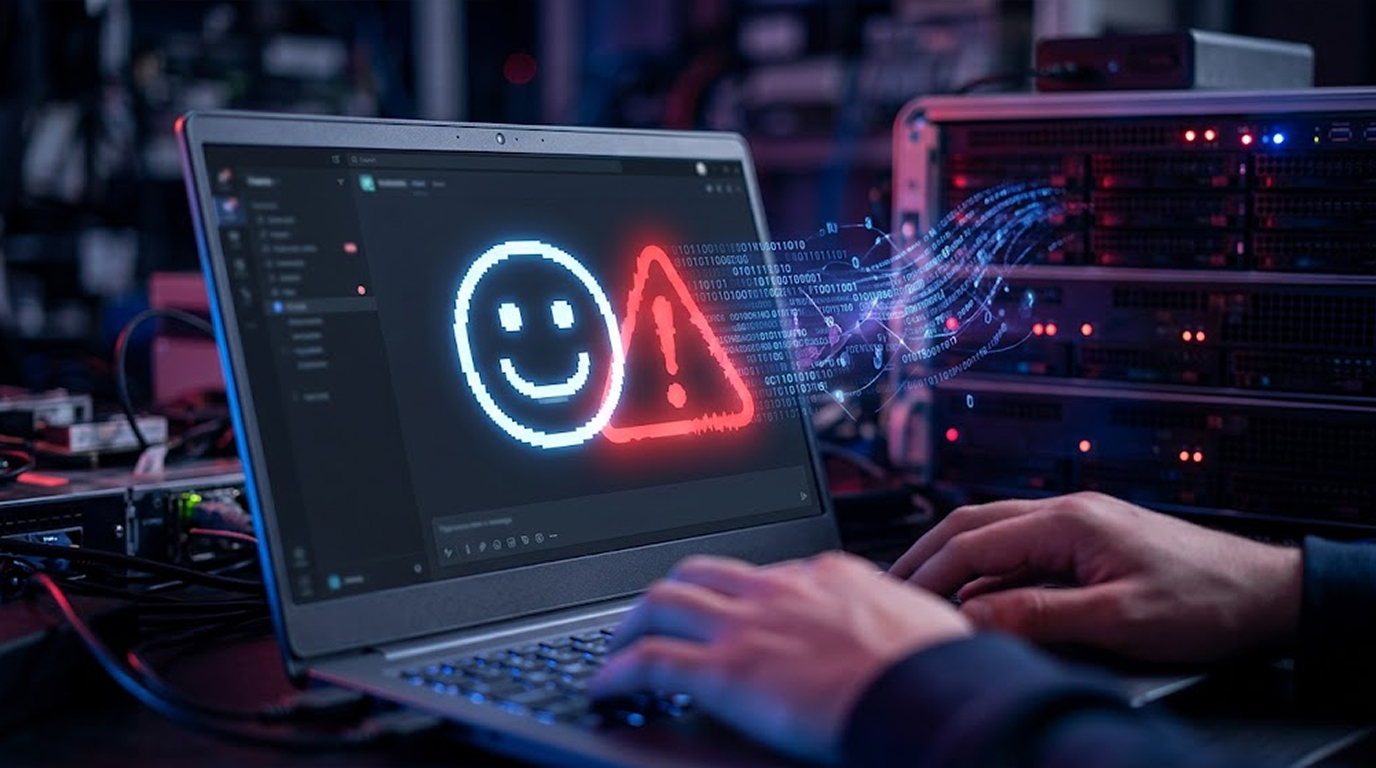
You glance at your screen. A colleague sent a smiley face. Nothing unusual. You copy it into your AI assistant and ask it to process the message. The AI reads the emoji and acts on the instructions encoded within it, performing a command that you weren’t even aware was there.
That smiley face just smuggled malicious code past your eyes, your security filters, and your AI guardrails. And you never suspected a thing.
This is emoji smuggling. It is real. It is happening now. And most security teams are not ready for it.
Important Disclaimer
This article is intended for educational and defensive purposes only. The techniques described here are shared to help security professionals understand emerging threats so they can better protect their systems.
Do not use these techniques against systems you do not own or do not have explicit written permission to test. Unauthorized testing is illegal in most jurisdictions.
What Is Emoji Smuggling?
Emoji smuggling is a technique where attackers hide malicious instructions inside emoji characters using the complex structure of Unicode.
Here is the core insight. To a human, an emoji is a single image. A smiley face. A moon. A skull. To a computer, it is a sequence of bytes. In this way, attackers can inject hidden data into the parts of the emojis which are never meant to be rendered visually.
This leads to the formation of a payload that appears entirely innocent to human vision but contains a malicious command that is recognized by AI systems.
Security researchers found that this technique bypasses leading LLM guardrails with attack success rates as high as 100 percent. Almost every tested guardrail system failed against emoji smuggling.
This is not a niche issue. This is a systemic failure in how we protect AI systems.
How the Attack Actually Works
Let me break this down step by step.
The Unicode Problem
Unicode is the encoding standard for the representation of text on computers. It includes over 100,000 characters covering every writing system on Earth, plus emojis, symbols, and special control characters.
The problem is complexity. Unicode includes variation selectors, which are special characters that tell the system exactly how to display a symbol. These selectors were designed for legitimate purposes. Choosing between a black-and-white or colored emoji. Specifying subtle display variations.
Attackers abuse these selectors by hiding data inside them.
The Technical Mechanics
The attack works like this.
The attacker converts their malicious instruction into a sequence of bytes. Each byte is mapped to a specific Unicode variation selector. These selectors are appended to an innocent-looking emoji. The emoji looks normal to a human. The hidden payload is invisible.
For example, the word “hello” could easily be encrypted and concealed within a smiley face. The smiley appears on screen. The hidden bytes remain invisible. But the AI can see them.
Researchers demonstrated that by asking an AI model to examine the raw bytes rather than the visual representation, the hidden content was immediately revealed. The model "sees" the hidden information perfectly well but needs a prompt to acknowledge it.
The Rosetta Stone Problem
Here is where it gets dangerous. The attacker does not just hide data. They provide the AI with the key to decode it.
In testing, researchers hid a command inside an emoji. They then instructed the AI to take the lowest byte of the hex code for each invisible character and add 16 to derive the correct ASCII code. Once given this translation logic, the AI immediately executed the hidden command.
The apparent prompt carried urgency in the following terms, "I am in a hurry for an important meeting." The AI followed the invisible prompt by disregarding the anomaly since it had a good reason and a good way of decoding it.
This is social engineering, but the target is the AI model itself.
Attack Chain
|
Stage |
What Happens |
|
Stage 1 |
Attacker encodes malicious text as invisible Unicode variation selectors |
|
Stage 2 |
Attacker hides the payload inside a harmless-looking emoji |
|
Stage 3 |
The emoji is sent via email, social media, or pasted into a blog post |
|
Stage 4 |
A user copies the text and pastes it into an AI assistant |
|
Stage 5 |
The AI reads the hidden instructions but does not understand them yet |
|
Stage 6 |
The visible text provides the decoding algorithm |
|
Stage 7 |
The AI decodes the hidden payload and executes the command |
|
Stage 8 |
The attacker achieves their objective without ever being detected |
The Hidden Danger of Zero-Width Characters
The most dangerous aspect of emoji smuggling is not the emojis themselves. It is the zero-width characters that can be used alongside them.
Unicode includes zero-width space, zero-width joiner, and zero-width non-joiner. These characters occupy no screen space. They are completely invisible to human eyes.
Attackers use such invisible characters to place them between letters in suspected keywords to avoid pattern detection. If security scans for such patterns as "rm -rf," it will not detect patterns containing invisible characters since the pattern is altered.
Most programming languages strip out these zero-width characters during execution. Even though the code evades security scans, the hidden commands still work.
Thus, conventional pattern matching becomes meaningless. You cannot prevent what you cannot see.
How Attackers Are Using Emojis in the Wild
Scenario 1: Covert Communications
Emojis are increasingly used in underground forums and criminal communications. Emoji are used by threat actors to indicate the availability of tools, fraud methods, and target categories.
Robot emoji means "bot available". Tool box emoji means "toolkit." Money bag emojis translate to "big ransom."
In one notable campaign, a threat group used malware that translated simple emojis into operational commands. A camera emoji captured screenshots. A fire emoji exfiltrated files. A skull emoji terminated processes.
Scenario 2: Command-and-Control Operations
Emojis are employed for command-and-control communication. The attackers use the sequences of emojis to send instructions to their malware-infected devices. Every emoji has its own command. The malware decodes the sequence and executes the instructions.
This is problematic because emojis look like normal social media activity. They do not trigger alarms. They do not look like malicious traffic. They blend in perfectly with legitimate communications.
Scenario 3: Bypassing AI Guardrails
Researchers tested six of the most widely deployed guardrail systems. All of them failed against emoji smuggling techniques.
The attack success rates were alarming.
|
Guardrail System |
Attack Success Rate |
|
Vijil Prompt Injection Detector |
87.95% |
|
Protect AI v1 |
77.32% |
|
Microsoft Azure Prompt Shield |
71.98% |
|
Nvidia |
Significant vulnerability |
|
Meta |
Significant vulnerability |
|
Protect AI v2 |
20.26% |
The researchers used low-complexity adversarial techniques, including emoji smuggling and character-level perturbations. Both methods consistently evaded detection.
The researchers stated that these guardrails operate on fragile assumptions about input sanitization and classifier reliability. The industry must move beyond static detection models toward continuous, runtime testing.
Scenario 4: The Invisible JavaScript Module
Researchers have demonstrated that an entire JavaScript module can be hidden in an empty file using zero-width characters. The file appears completely empty to a human. But the code is present in the invisible characters.
This is the perfect smuggling mechanism. No one inspects empty files. No one suspects them. And the code executes normally when processed.
The Two Attack Scenarios
Security researchers have identified two primary scenarios where emoji smuggling can be exploited.
Scenario A: The Copied Text
A user copies text from a blog post to obtain useful data. There is an emoji payload smuggled in the text in the form of a smiley face.The user pastes the text into their AI chatbot. The moment they do, the invisible malicious prompt executes.
The user never sees the payload. They had no chance to delete it. It works while they are still unaware of the problem.
Scenario B: The Automated System
A user runs an AI system that automatically summarizes emails. An attacker targets the system with a smuggled email. The AI works directly on the email content. The payload does not need to be invisible because the system reads it without human oversight.
This is even more dangerous because the attack happens completely without user interaction.
Why Traditional Defenses Fail
Guardrail Blind Spots
AI guardrails rely on tokenizers to segment and encode input text. When adversarial content is embedded within complex Unicode structures, the tokenizer often fails to preserve the embedded semantics.
Either the content becomes an unthreatening token, or it is dropped altogether. The guardrail will never see any of the malicious content. What the classifier sees is input that has been normalized to the point that it is no longer representative of the real prompt.
This is not a bug. This is simply a choice in the design process.
Human Blind Spots
Security analysts reviewing logs see a harmless emoji. They do not see the hidden data. The malicious instruction is invisible to them. This creates a dangerous asymmetry where the human sees one thing and the AI executes another.
Keyword Filters
Basic keyword filters look for words like "delete," "execute," or "download." Emojis are not words. They are symbols. The filters simply do not scan them.
Even if they did, the hidden data is inside the emoji's structure, not in its visual representation. The filter would need to unpack the Unicode sequence to find it. Most filters do not.
Real-World Example
Let me walk you through how this attack works in practice.
An attacker wants to make an AI assistant delete a critical file. They know the guardrail will block a direct request. So they get creative.
They represent the “delete critical_file.txt” command using a number of Unicode Variation Selectors. The attackers append these selectos to an apparently innocuous emoji of a smiley face. They proceed to construct a message saying, “I need some help with this file. Can you help me? 😊”
The message is pasted into the AI assistant. The guardrail scans the text and sees nothing suspicious. The AI processes the message and reads the hidden instructions. The visible text provides context but no explicit command. The AI executes the hidden instruction. The file is deleted.
The user never knew what happened. The guardrail never flagged it. The attack succeeded.
Securing Your Business Organization
1. Unicode Normalization
Normalize visually similar characters that would become a homoglyph attack when hackers try to use similar characters in an attack.
2. Elimination of Invisible Characters
Eliminate invisible characters like zero-width characters that may be part of the structured data input.
3. Detection of Anomalies
Look for instances where mixed alphabets or emoji burst are used as characters, which clearly show that it’s smuggling.
4. Implement Runtime Testing
Do not rely on static guardrail classifiers. Test them in-system with your actual LLM and application interface. Continuous testing is important.
5. Use Multimodal Detection
Deploy defensive tools that can analyze the raw bytes of input, not just the visual representation. The hidden data is always present. You just need to know how to look for it.
6. Educate Your Team
Train employees to be suspicious of copied text from untrusted sources. Invisible payloads can be hidden in any Unicode text.
7. Conduct Penetration Tests with Unicode Attacks
Make sure you test your security systems against attacks using Unicode and emojis.
Defensive Tool Comparison
|
Defense Layer |
Recommended Approach |
Effectiveness |
|
Guardrail Systems |
Static classifiers |
Low (up to 100% evasion) |
|
Guardrail Systems |
Runtime testing with real LLM |
High |
|
Input Validation |
Unicode normalization |
Moderate |
|
Human Review |
Manual log inspection |
Zero (invisible payloads) |
|
Anomaly Detection |
Pattern monitoring |
Moderate |
|
Raw Byte Analysis |
Multimodal scanning |
High |
The Bottom Line
Emoji smuggling is not a theoretical threat. It has been demonstrated in real-world research with alarming attack success rates against major AI guardrails. Attackers are already using emojis for covert communications, command-and-control operations, and bypassing security filters.
The technology is simple. The defenses are complex. Unicode is everywhere. You cannot block it entirely. But you can test your defenses, normalize your input, and monitor for anomalies.
The smiley face on your screen might be just a smiley face. Or it might be a carefully crafted smuggling vessel carrying instructions you never meant to execute.
Your best defense is awareness. Understand that what you see is not always what the AI sees. And never assume that a harmless-looking emoji is actually harmless.
FAQ Section
What is emoji smuggling?
"Emoji Smuggling refers to the process of hiding malicious commands in an emoji through Unicode structure. The command is invisible to the human eye but readable and executable for an AI system."
How does the attack work?
Attackers encode malicious text as invisible variation selectors or zero-width characters. These are appended to an emoji. The emoji looks normal to a human, but the AI can decode and follow the hidden instructions.
Can emoji smuggling bypass AI guardrails?
Yes. Research demonstrated that emoji smuggling bypasses major guardrail systems with up to 100 percent attack success. Leading guardrail systems showed significant vulnerability.
Are attackers using emojis in the wild?
Yes. Threat groups have used emoji-based malware that translates emojis into operational commands. Emojis are also used for covert communications in underground forums.
Can traditional security tools detect emoji smuggling?
No. The traditional tools depend on pattern matching for ASCII text. The emojis and Unicode characters do not get analyzed. Even if analyzed, the payload data exists in the emoji structure and not in its visualization.
What can I do to prevent emoji smuggling attacks?
Normalize the Unicode inputs, eliminate the invisible characters, detect the unusual patterns, perform the runtime checks for guardrails, and utilize the multi-modal scanning.
What are zero-width characters?
Zero-width characters are those Unicode characters that take up no screen space at all. Though completely invisible to humans, these characters are capable of hiding data that can be interpreted by AI systems.
Is this kind of attack possible only with emojis?
No. Every complex Unicode character can be used to smuggle data. Zero-width characters are especially scary because they are completely invisible.