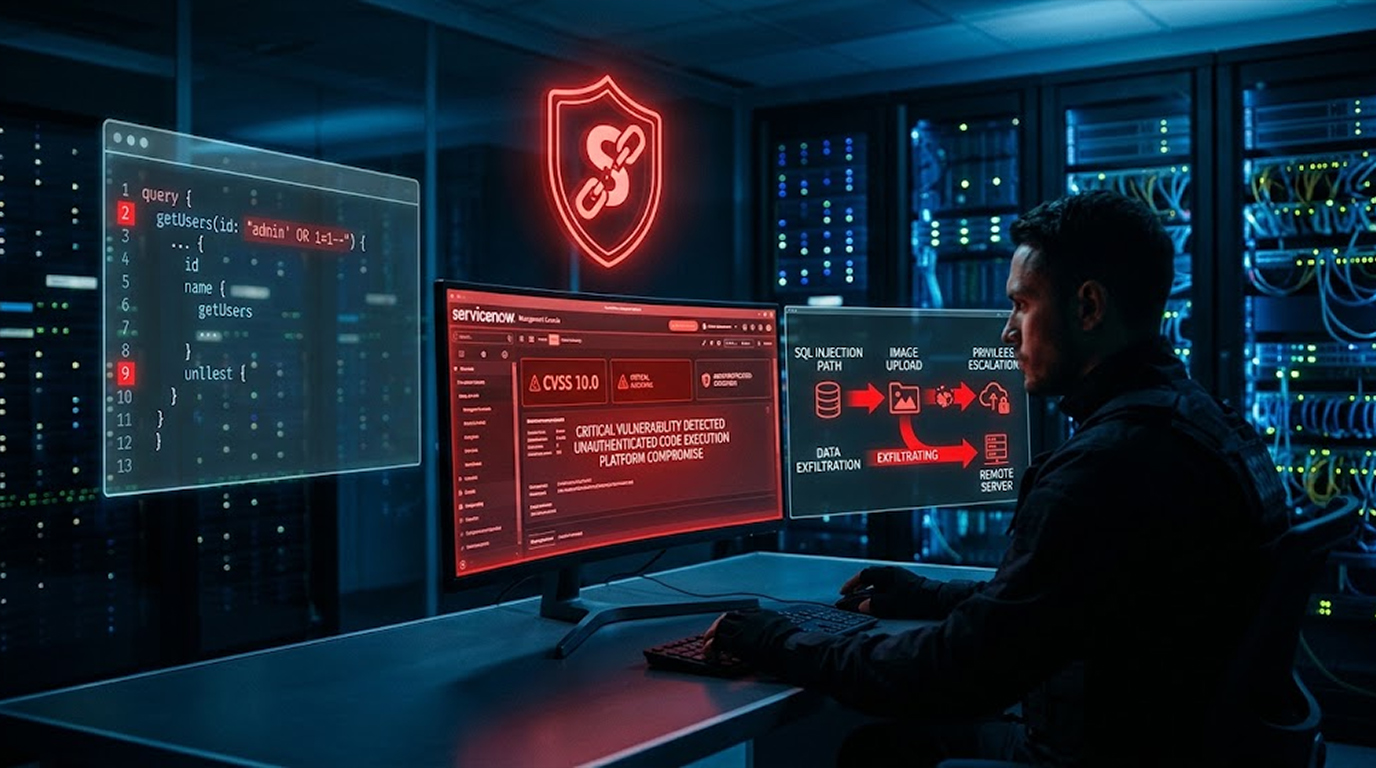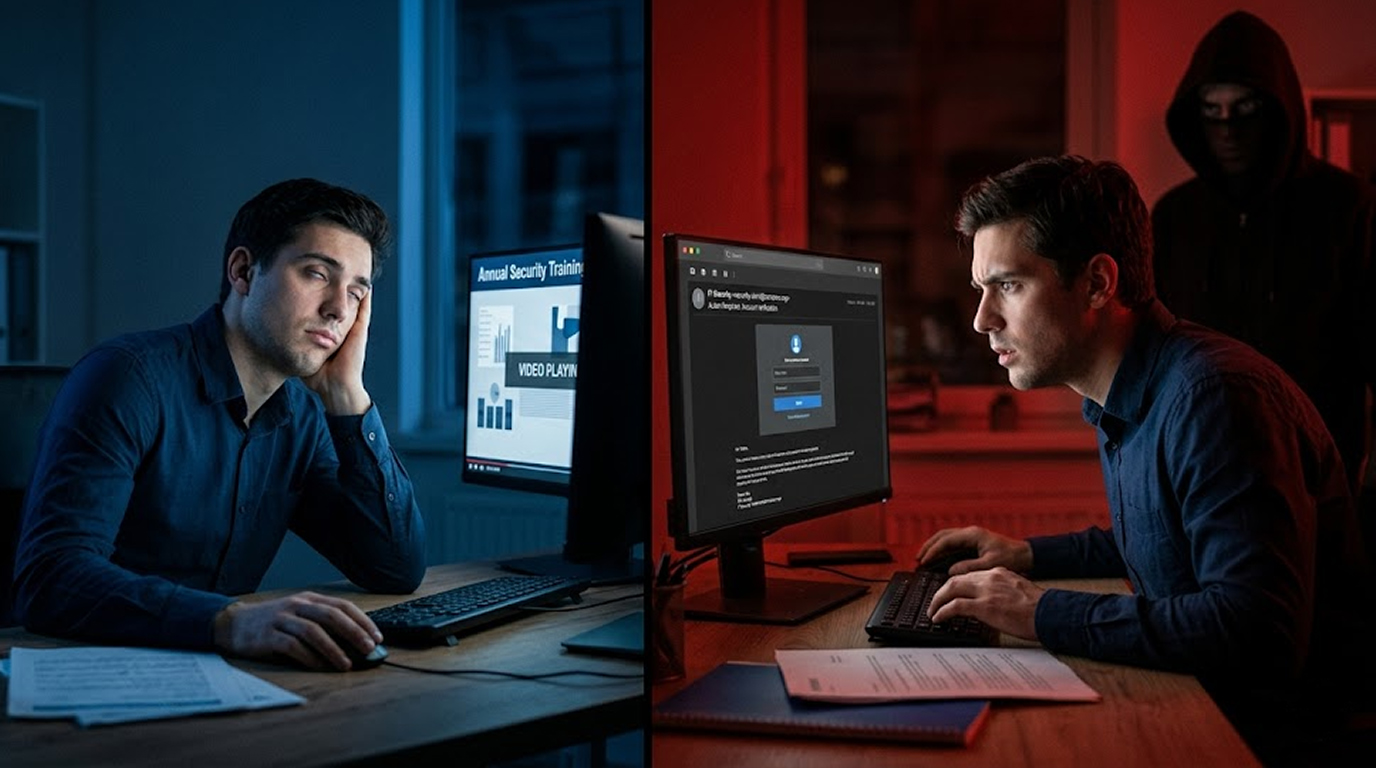
Last month you conducted a phishing simulation, and 85% of the employees who completed it passed; you felt good about this statistic. However, a real attack occurred, and someone from your company still clicked on a phishing email.
You retrained your employees, sent them reminders, and provided them with examples of what to look for to avoid becoming a victim of social engineering; yet, another employee was also tricked into providing his/her password over the phone.
Your training program is failing and is not due to the carelessness of your employees, but rather that social engineering has greatly evolved, while your training program has not.
Let me tell you why traditional security training is not working, and what does work in 2026.
The Hard Truth
Security training as we know it is broken.
The average employee receives security training once per year, usually a 30-minute video followed by a quiz.
They click through, memorize the answers, pass the test, and forget everything within a week.
Meanwhile, attackers are running hundreds of simulations against your employees every single day, real ones, not fake ones.
They adapt, they personalize, they use AI, and they are getting better.
Your annual training video does not stand a chance.
Companies like Red Secure Tech specialize in understanding how modern attackers think, they bring this offensive mindset to help businesses defend against evolving social engineering tactics.
How Social Engineering Has Changed
Social engineering in 2026 looks nothing like it did five years ago.
Attackers have abandoned the obvious, no more "Nigerian prince" emails with terrible spelling.
They have moved to surgical, personalized attacks that bypass traditional defenses.
how social engineering has evolved :
|
Then |
Now |
|
Generic emails sent to millions |
Personalized messages for each target |
|
Obvious spelling and grammar errors |
Perfectly written using AI |
|
Suspicious sender addresses |
Spoofed or compromised legitimate accounts |
|
Generic greetings like "Dear Customer" |
References to real projects, coworkers, and events |
|
Single channel (email only) |
Multi-channel (email, SMS, phone, LinkedIn, Slack) |
|
Obvious urgency ("Your account will close") |
Subtle psychological manipulation |
Your employees have been trained to be able to recognize bad grammar and suspicious sender addresses.
Modern attacks have neither.
The training is teaching yesterday's defenses against yesterday's attacks.
Red Secure Tech simulate real-world social engineering attacks to show you exactly where your human defenses are failing before a real attacker exploits them.
Reason 1: AI-Generated Phishing Is Perfect
AI has changed the game for attackers.
In the past, phishing emails were often easy to spot, odd phrasing, strange word choices, inconsistent formatting.
Today, attackers use large language models to generate perfect phishing emails.
How can you recognize Phishing generated from Artificial Intelligence?
Look for these warning signs:
1. Does the email address consist of your company’s tone or style?
2. Are there spelling mistakes in the email?
3. Is the sender’s name that of either an employee or someone you know?
4. The email is discussing legitimate projects, recent events, or appears to have used internal knowledge obtained from places like LinkedIn and Social Media.
5. Employees who have little to no understanding of language cannot tell the difference between emails written by humans and emails created from AI.
So, there is no clear method of telling!
What your training says: Look for bad grammar and spelling mistakes.
What actually happens: There are none, the employee never suspects a thing.
Reason 2: Multi-Channel Attacks Confuse Everyone
Attackers no longer rely on email alone.
They call, they text, they message on LinkedIn, they ping on Slack, they use WhatsApp.
A real 2026 attack scenario:
An employee receives a text message (smishing) that appears to be from the IT department.
The message says there is an urgent security update and provides a link.
The employee ignores it, good training.
Ten minutes later, they receive a call from someone claiming to be from IT support, the caller mentions the same text message.
They say, "You probably got a weird text, that was a test from our security team, we just need to verify a few things."
The employee relaxes, they were just told the suspicious text was a test.
They answer the caller's questions and give away their password.
The attacker used the employee's suspicion against them, the first message built skepticism, the second message exploited that skepticism to gain trust.
Your training taught employees to be suspicious of unexpected messages.
It did not teach them what to do when a second message explains away the first one.
Reason 3: Vishing (Voice Phishing) Is Back and Worse
Phone-based social engineering declined for a few years, it is back with a vengeance.
Attackers use voice AI to sound like anyone, a coworker, an executive, a help desk agent.
How modern vishing works:
1. The attacker researches your company by using LinkedIn and other public records.
2. They make an outbound call to one of your employees using a spoofed caller ID that appears to be an internal number for your organization.
3. They use a deepfake voice or a scripted conversation to sound very authoritative and believable.
4. They tell the employee a plausible story, i.e., they did not receive a payment or there is a security issue or a vendor needs to validate something.
5. The employee has no visual clues (i.e., there are no visual cues available) and cannot see the email headers (i.e. - they cannot see the sender address, date/time, etc.) of the email, nor can they click on a link to verify it.
6. They only have a voice over the phone as proof that the caller is legitimate.
Your training tells you to never give out your password over the phone
But generally, what happens is that the caller does not ask for your password; however, they will ask you to provide them with your verification code, badge #, system login, or access to an application.
Generally, the employee doesn't understand that they are giving out access because their request is legitimate-sounding!
Reason 4: The Training vs Reality Gap
Security training is typically delivered in a classroom or online module, safe, quiet, and obvious.
Real attacks happen in the real world, noisy, stressful, and subtle.
The gap in action:
|
Training Environment |
Real Attack Environment |
|
No time pressure |
Artificial urgency ("Do this now") |
|
Perfect attention |
Distracted by actual work |
|
Obvious red flags |
Subtle manipulation |
|
No consequences for reporting |
Fear of looking foolish |
|
Practice scenario |
Real stakes |
Your employees know what a phishing email looks like in a training video.
In real life, they are juggling deadlines, responding to customers, and trying to finish their actual job.
The attacker only needs one moment of distraction.
A professional vulnerability assessment from Red Secure Tech can help you identify where your security awareness program falls short and provide actionable recommendations to close the gap.
Reason 5: Employees Are Afraid to Report
Here is something training metrics do not show.
Most employees who almost fall for a phishing attempt do not report it.
They delete the email and move on, hoping no one noticed.
Reasons why people do not report:
1. They are embarrassed and feel they should have known better.
2. They are afraid they will get into trouble for reporting.
3. They do not want to be the reason that slows down the entire team.
4. They think it’s not a big deal that they did not click on something.
Cyber criminals understand this and build their attacks in a way that causes an employee to hesitate before reporting the attack as suspicious. An employee who is 80% sure something is suspicious will typically choose to ignore the event rather than report it.
Training provided by companies has taught employees to report suspicious messages; however, it has not dealt with the reason they are too embarrassed or afraid to report suspicious messages.
Reason 6: Simulations Are Not Realistic
Most phishing simulations are terrible.
They use obvious fake emails, cartoonish warnings, and unrealistic scenarios.
Employees learn to spot the simulation, not the real attack.
What bad simulations look like:
The email is sent from "Security Awareness Team" with a subject line "Phishing Test."
The link goes to a training page with a popup that says "You clicked a phishing link."
The simulation has no follow-up, no conversation, no pressure.
What real attacks look like:
The email blends in with real messages.
The link goes to a convincing fake login page.
The attacker follows up with a phone call or text message.
The employee is under real pressure.
Your simulation is training employees to pass your simulation, not to resist real attackers.
If your simulation is not indistinguishable from a real attack, you are not measuring anything useful.
What Actually Works in 2026
Throwing away training is not the answer, but continuing the same failed approach is also not the answer.
Here is what security teams need to do instead.
Shift 1: From Annual to Continuous Training
One training session per year is not enough, attackers learn and adapt daily, so should your employees.
What can you do:
You can develop mobile training videos that will train employees throughout the year. Create many shorter (2-3 minutes), weekly micro-trainings. Then provide live training with examples of incidents that happened recently in your particular industry. You can also perform realistic testing once per month instead of every three months or twelve months.
Why it works: The most effective way to create a habit is to provide employees with the opportunity to practice and build that habit until it becomes second nature, this will reduce or eliminate the amount of panic they feel when faced with a potential threat incident.
Shift 2: Classroom to Real Time
Employees will be most receptive to learning when they have just experienced a situation that could pose a risk to their job.
What you can do:
When an employee reports a suspicious email, give them a quick explanation as to why it was suspicious.
When an employee clicks on a simulation link to report an exposure, let them know immediately what they clicked on and why it was dangerous.
Use your email gateway to insert brief security reminders into real emails that contain suspicious elements.
Why this works: Learning sticks when it is immediately relevant.
Shift 3: From Blame to Support
Employees do not report mistakes because they are afraid, remove the fear.
What to do:
Avoid punishing your employees for not completing a simulation or for failing to report a legitimate threat. Training can be completed as part of the training process.
Recognize employees that report suspicious emails/activities, send them a "thank you" note, and give them a small (but meaningful) reward.
Provide statistics about how many threats you stopped during the time period; do not identify who it was.
Why this works: Employees who are not afraid report more, reporting catches attacks before they spread.
Shift 4: Move from Email-only Training to a Multi-channel Approach.
Training should focus on all the channels that attackers use for communication—phone (voice), text message (SMS), messaging apps, social media etc.
How to do this:
Conduct vishing (voice phishing) simulations by having an actor call your employees attempting to elicit information via phone calls.
Send smishing (SMS/phishing) simulations that mimic the type of messages you ordinarily receive (i.e. shipping notifications or security alerts).
Conduct testing on how employees respond to unexpected unsolicited LinkedIn messages from "recruiters" and "vendors."
Why this works: Attackers use all channels, training must cover all channels.
Shift 5: From Technical to Behavioral
Technical red flags (misspelled domains, bad grammar) are disappearing.
The training should also now include behavioral red flags (urgency, authority, and emotional manipulation), which can teach employees to identify.
The following behavioral warning signs can lead you to believe an attack may be occurring:
1. A person who is trying to get your personal details by pretending to be asking questions about something else such as a call asking you for your Card Number.
2. A request for information from someone by email(s) such as "I need your account Number at XYZ. What is it now?" that has been very long winded and is an urgent response.
3. Failure to comply with your organization’s procedures to request personal or sensitive information from you.
4. Trying to elicit some type of emotional response (fear, curiosity, excitement, kindness, or good faith) from you in order to obtain sensitive information from you.
For the most part, behavioral warning signs will be much more challenging for an individual attempting an attack to copy compared to technical warning signs.
Shift 6: Passive to active
Watching videos is a passive activity, while the practice of how to respond is an active one. For example, you can run actual scenarios through simulated attacks and then work with your coach to learn appropriate responses.
Playing decision games where employees choose what to do in a variety of situations and see how their choices affect the outcome.
Practicing the reporting process so employees know who to report what to, and how to report it.
Active learning develops memories and confidence that passive learning cannot.
Red Secure Tech provides structured penetration testing and security assessment services that include social engineering simulations that will test your human security against real 2026 tactics, not old tactics.
The Bottom Line
Your employees are not the problem, the training is.
Attackers have evolved, they use AI, they use multiple channels, they use psychology.
Your annual training video with obvious fake examples cannot compete.
To defend against 2026 social engineering, you need continuous, active, multi-channel training that focuses on behavior, not just technical red flags.
You need to remove the fear of reporting and celebrate employees who catch real threats.
And you need realistic simulations that look and feel like actual attacks, not obvious tests.
The attackers are getting better, your training must get better too.
Your employees can be your strongest defense, but only if you train them for the attacks they actually face, not the attacks of five years ago.
Ready to Test Your Human Defenses
If you are unsure whether your security training is working, the first step is to test it.
A realistic social engineering assessment reveals exactly where your employees are vulnerable and what type of attacks are most likely to succeed against your organization.
Red Secure Tech offers professional penetration testing and social engineering service that use 2026 attack methods as they are going to occur in the real world.
These types of tests include:
1. Phishing attacks created by Artificial Intelligence
2. Vishing (voice phishing) and Smishing (SMS phishing)
3. Integrated attack scenarios that use multiple channels of contact
4. Complete reporting and remediation suggestions
👉 To learn more about the company or to schedule a consultation, go to https://www.redsecuretech.co.uk
FAQ Section
Why isn't traditional security training effective anymore when it comes to social engineering?
Traditional training only teaches you to look for technical warning signs, such as poor spelling and grammar and suspicious email addresses. We have eliminated all these types of warning signs in modern attacks through the use of AI technology.
In addition to eliminating traditional warning signs, attackers are now also using multiple communication methods (i.e. email, phone, text message). Lastly, attackers today are more likely than ever before will try to manipulate the victim's mind with psychological tricks that employees have not been prepared for with annual training.
How should companies best educate employees regarding modern phishing threats?
The best approach for educating employees on how to avoid falling prey to modern phishing is through ongoing, hands-on, and multiple forms of training (i.e. video training, web-based training, etc.).
Annual video training should be replaced with weekly "micro" training sessions (2-3 minutes), realistic phishing tests through email, phone, & text should be conducted, and employees should learn to recognize behavioral patterns (i.e. urgency and authority abuse) that might suggest a potential phishing attempt.
How can I test if my employees would fall for real social engineering attacks?
A professional social engineering assessment simulates real-world attack techniques safely, Red Secure Tech offers controlled phishing, vishing, and smishing simulations that test your human defenses without risking actual compromise.
Why do employees fail phishing tests even after training?
Employees fail because training does not match reality, real attacks happen when employees are distracted, under time pressure, and facing sophisticated manipulation, also many employees who suspect something is wrong do not report it because they are afraid of looking foolish.
How often should security training be delivered to be effective?
Annual training is not enough, security awareness should be delivered in short, frequent sessions (2-3 minutes weekly) with realistic simulations monthly, this builds habits rather than temporary awareness that fades within weeks.