Harvest Now, Decrypt Later is a long-term attack strategy where adversaries collect large amounts of encrypted data today (emails, VPN sessions, financial records, medical files, intellectual property, government communications) and store it for years or decades. They wait until sufficiently powerful quantum computers can break the public-key cryptography currently protecting that data (primarily RSA and ECC).
Once a cryptographically relevant quantum computer (CRQC) exists, they decrypt the archived material retroactively.
In 2026 this is no longer a distant future concern, it is treated as an active, ongoing risk by national security agencies, major cloud providers, financial regulators, and most serious cybersecurity organizations.
Why HNDL Is Taken Seriously Right Now
1. Several advanced threat actors are already known to be systematically collecting encrypted traffic they expect will become decryptable later.
2. Leading security authorities have publicly stated that organizations should assume some of their currently encrypted data has already been harvested under HNDL tactics.
3. NIST has officially deprecated many widely used algorithms (RSA-2048, ECC-256, Diffie-Hellman < 3072-bit) because they are vulnerable to future large-scale quantum attacks (Shor’s algorithm).
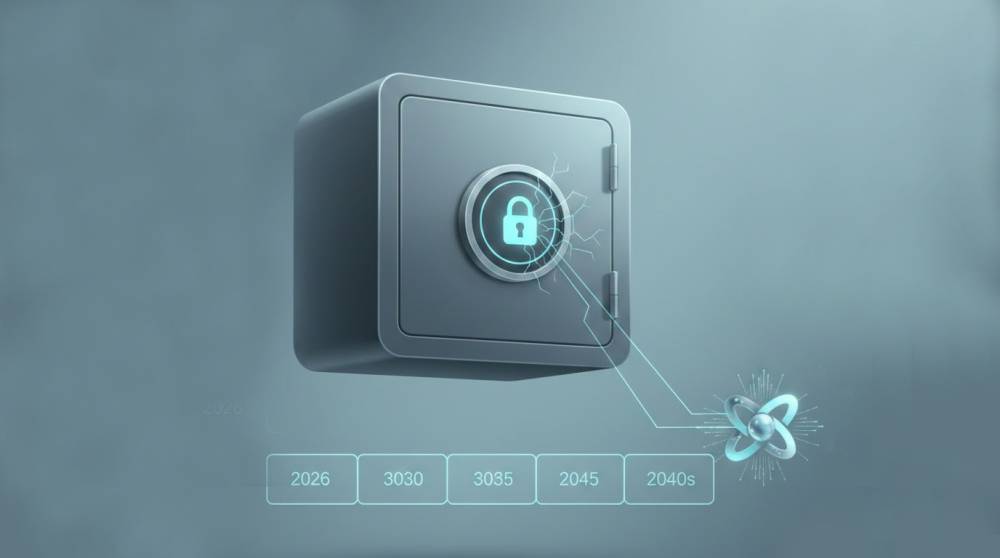
4. Quantum progress accelerated in 2025–2026: several labs demonstrated logical qubits with meaningful error correction, bringing median expert estimates for a CRQC capable of breaking RSA-2048 to roughly 2030–2040 (most common view around 2035).
Types of Real-World Data Likely To Be Targeted by HNDL
1. Medical & Genetic Data: longitudinally stored encrypted medical records, and/or DNA sequence data. Future decryption could potentially expose hereditary health risks, establish paternity or enable blackmail/extortion as many decades pass.
2. Financial & Insurance Records: decades-long encrypted records of transactions, insurance policies and investments. Retroactive decryption could reveal hidden assets and income and/or enable sophisticated identity theft/fraud.
4. IP & Trade Secrets: encrypted research and development (R&D) roadmaps, merger and acquisition (M&A) documents, and source code repositories. Decrypting them 10 - 20 years from now could completely eliminate competitive advantage for those who currently possess them.
5. Government & Defense Communications: classified emails, VPN tunnels and satellite links secured by pre-quantum decryption algorithms. If decryption occurs, it will expose various historical sources for diplomacy as well as many current diplomatic stances.
6. Personal long-term data: Encrypted cloud backups, password managers (if using legacy key exchange), old email archives containing sensitive life events.
Practical Steps You Can Take in 2026
You Cannot Remove Data that Has Already Been Collected; however, You Can Limit Future Risk by:
1. Move to Post-Quantum Cryptography Now (PQC)
a. Switch to using apps and services that are based on PQC (e.g. use Signal app, WhatsApp via PQ-XDH, WalMart's use of Cloudflare Hybrid TLS, AWS/Azure's signal use of PQC mode, and Chrome/FireFox PQC based hybrid key exchange).
b. Migrate Data to (age using ML-KEM) or to OpenSSH Hybrid Key based on PQC.
2. Limit Long-Term Sensitive Encrypted Data
a. Remove old backup data that you no longer want or require; (i.e., delete long-held data that is no longer required).
b. Use Forward Secure Cryptographic Protocols Whenever Possible (e.g., something similar to Signal’s Ratcheting Protocol) rather than Long-Term Static Keys (roughly equivalent but requires more work).
3. Hybrid Cryptography Should be Used Whenever Possible
a. Hybrid - Combination of Classical and PQC (i.e., X25519 as Classical & ML-KEM as PQ); Regardless of what happens to Classical, you still have security using PQC component.
4. Legacy Encrypted Data is Suspect
a. Use extreme caution when dealing with any Data Encrypted Prior to Approximate Submission of Q3 FY20Q24-QFY25 using Classical PK Cryptography such as RSA-2048/ECC-256/Class Diffie-Helman may lead to potential future decryption of the Data.
Key Takeaways
Hazard Now, Decrypt Later is a fully developed strategic state-level attack that will begin in 2026. Adversaries have begun harvesting encrypted data today with a credible estimate that they can break all forms of public key cryptography using quantum computers within ten to twenty years from now.
The most valuable targets for these attacks will be any type of long-term record containing sensitive data (e.g., medical records, financial records, intellectual property, government communications, etc.). Therefore, individuals and organizations should be in the process of migrating to NIST approved post-quantum algorithms (ML-KEM/Kyber, ML-DSA/Dilithium, etc.).
Furthermore, they should be using hybrid encryption modes, limiting the amount of long-term encrypted storage of sensitive data, and assuming that any legacy encrypted data may already be in the possession of an adversary.